Ever since 2016, something feels… off. Not politically—that’s obvious—but temporally. Time itself seems to be moving faster. Weeks disappear, years stack up like days, and entire eras of headlines blur into a single, nonstop reel.
Let’s just get the basics out of the way: yes, as people age, time feels faster. And yes, modern life moves quickly. Fine. That’s the polite explanation.
But that’s not what people are talking about.
They’re talking about the Trump Effect.
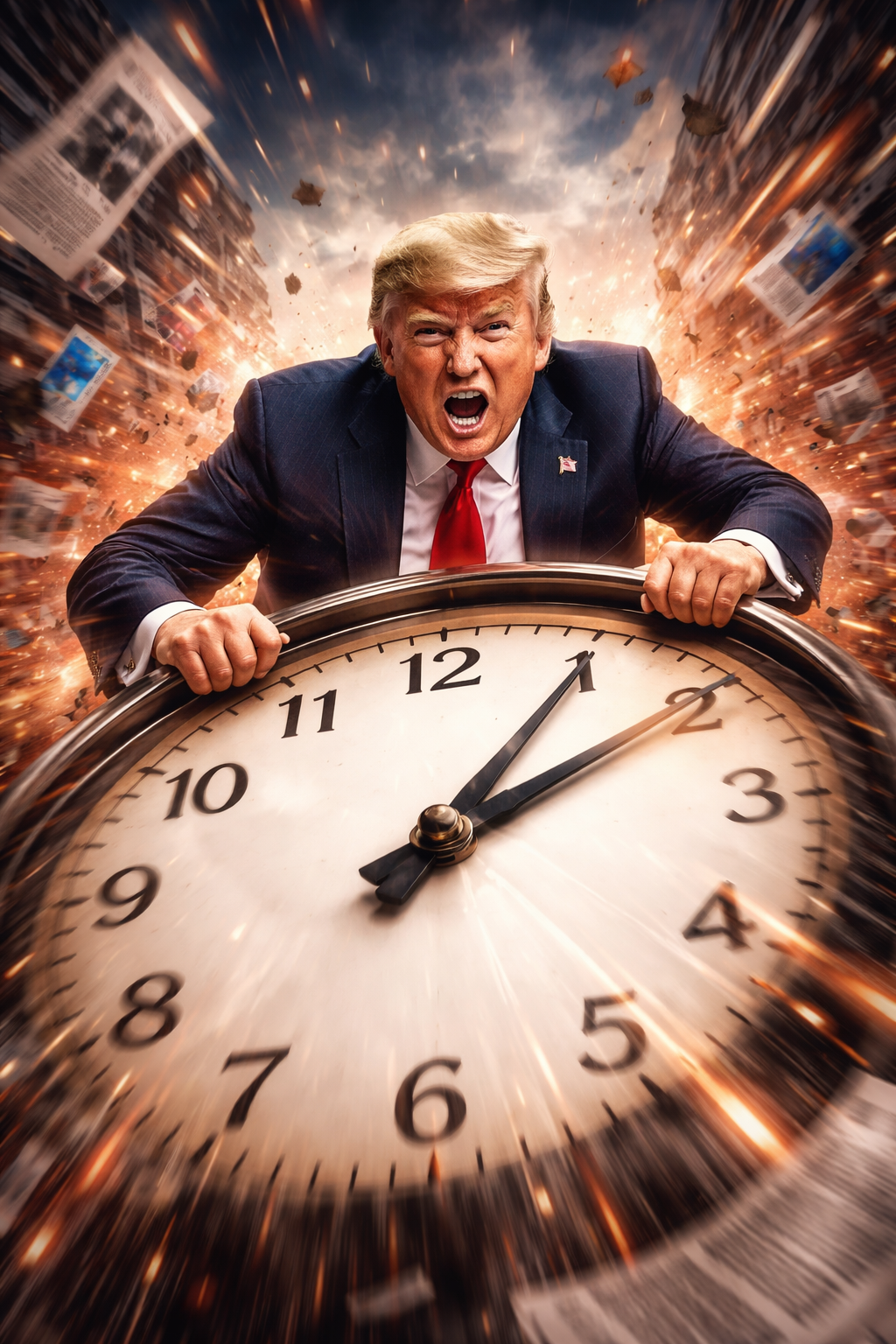
The Day the Clock Broke
When Donald Trump came down that escalator in 2015, it wasn’t just a campaign launch—it was the beginning of a completely new time structure in American life.
Before Trump, the news cycle was… well, a cycle. Stories lasted days. Sometimes weeks. Big events had breathing room. There was a rhythm.
After Trump?
The cycle didn’t just speed up—it shattered.
One day could contain:
- A major policy announcement
- A global diplomatic incident
- A viral cultural moment
- And three “this would have been a scandal in any other era” headlines
All before dinner.
Your brain wasn’t designed for that.
Cognitive Overload and Time Compression
From a scientific standpoint, the brain measures time based on how it encodes memories. Distinct, spaced-out events create a sense of longer duration. But when events pile up rapidly—especially emotionally charged ones—the brain starts compressing them.
Trump-era media created the perfect storm:
- High novelty
- High emotional intensity
- No pause between events
The result? Your brain logs less detail per event, even though more is happening.
So instead of 1,000 distinct memories, you get one giant blur labeled: “2017… or maybe 2019… who knows.”
That blur is what feels like time accelerating.
The Permanent “Breaking News” State
Trump didn’t just dominate the news—he redefined its frequency. Every day became “breaking news.” Every hour felt like it mattered.
That constant urgency triggers something important: your brain shifts into a kind of low-level survival mode. It pays attention—but it doesn’t store.
Think of it like trying to remember every tree while driving 100 miles per hour through a forest.
You saw a lot. You retained almost nothing.
Why It Didn’t Stop
Here’s the part people don’t like to admit:
The Trump Effect didn’t end when he left office.
The system adapted to him. Media, politics, and public attention all recalibrated to that pace—and once you normalize chaos, “normal” feels slow and irrelevant.
So the tempo stayed high. The compression continued.
And now, years later, people are looking back and asking:
“How did we get here so fast?”
The Physics Angle (Because Someone Always Goes There)
No, time itself hasn’t changed. Theory of Relativity still applies, and unless Washington, D.C. secretly achieved orbit during a press conference, the clocks are fine.
But perception is everything.
And perception has been under siege.
A Blunt Take
Here’s the honest version:
Trump didn’t speed up time.
He flooded the system.
He created such a high volume of headline-level moments that the human brain—built for slower, more structured narratives—started dropping frames just to keep up.
It’s not that nothing stuck.
It’s that too much happened to stick properly.
Final Thought
If the years since 2016 feel like one long, continuous “breaking news” banner, you’re not imagining it.
That’s the Trump Effect.
Not a change in time itself—but a change in how time is delivered to the human mind.
And once you’ve experienced that kind of acceleration…
Going back to normal feels almost impossible.