By Joel Pilon for Digital Media USA
There are trees in America that provide shade. There are trees that provide lumber. There are even trees that provide maple syrup, Instagram photos, and enough pollen to make half the Midwest sneeze itself into another dimension every spring.
And then there’s the Osage orange — perhaps the strangest, toughest, and most symbolically American tree most people have never really thought about.
Known scientifically as Maclura pomifera, the Osage orange goes by many names across the American heartland: bois d’arc, bodark, hedge apple, horse apple, bow-wood. It grows twisted and thorny across the old Louisiana Purchase territories — from Arkansas and Oklahoma through Texas, Missouri, Kansas, and beyond — standing like a living relic from another age.
But hidden deep within the folklore surrounding this bizarre green-fruited tree is a connection that reaches far beyond prairie fences and pioneer farms. According to generations of frontier lore, this may be the only truly American native tree tied — however symbolically — to the Bible itself.
And honestly? That’s one heck of a story.
The roots of this tale stretch all the way back to the 1803 Louisiana Purchase, when President Thomas Jefferson doubled the size of the young United States in one gigantic geopolitical land deal. Overnight, America inherited an immense interior wilderness — rivers, plains, forests, mountains, and ecosystems largely unknown to the eastern establishment at the time.
As settlers, surveyors, explorers, and traders moved westward into these newly acquired lands, they encountered the Osage orange in abundance. The tree thrived precisely within the central corridor of the Purchase territory, particularly throughout regions inhabited by the Osage Nation, from whom the tree ultimately derives its modern name.
The French called it bois d’arc — “wood of the bow” — because Native American tribes prized its wood for making exceptionally strong hunting bows. In fact, the wood was so valuable that finished Osage bows were traded across enormous distances throughout North America long before Europeans arrived.
And for good reason.
Osage orange wood is astonishingly dense, flexible, insect-resistant, and nearly rot-proof. Fence posts made from it have been known to last for generations. Before barbed wire transformed the American West, settlers planted entire living walls of Osage orange hedges to fence cattle and define property lines across the prairie. In many ways, the tree literally helped shape and organize the expanding American frontier.
But the deeper folklore connection emerges from the name itself.
For generations, frontier Americans noticed the curious similarity between bois d’arc and the biblical word “Ark.” Over time, folk traditions began associating the tree with the mysterious “gopherwood” described in Genesis 6:14 — the material God commanded Noah to use in the construction of Noah’s Ark.
Biblical scholars have never definitively identified what “gopherwood” actually was. The Hebrew term appears only once in Scripture. Some theories suggest cedar. Others point toward cypress or resinous timber native to the ancient Near East. Nobody truly knows.
But on the American frontier, symbolism often mattered as much as certainty.
To settlers carving civilization out of the wilderness, the Osage orange seemed almost providential: an extraordinarily resilient tree growing directly within the newly opened territories of the Louisiana Purchase — territories that represented freedom, expansion, self-government, and the bold American experiment itself.
And that symbolism resonated deeply with Americans whose political worldview had already been shaped by older ideas flowing from the Magna Carta, constitutional liberty, and biblical tradition.
Whether the “bois d’arc / Ark” connection is linguistic coincidence, frontier mythology, or something more poetic depends entirely on who you ask around the campfire.
But the symbolism remains undeniably compelling.
Unlike figs, olives, cedars of Lebanon, or other traditional biblical plants imported from the Old World, the Osage orange is uniquely North American. It belongs to the continent itself. It is a native survivor — a thorn-covered relic from prehistoric ecosystems that once stretched across the middle of America.
And somehow, through folklore, language, frontier imagination, Native ingenuity, French exploration, and American expansion, it became spiritually woven into the mythology of the land.
That’s the thing about America. Sometimes history isn’t sitting in museums.
Sometimes it’s growing crooked along an old fence line in the middle of nowhere.
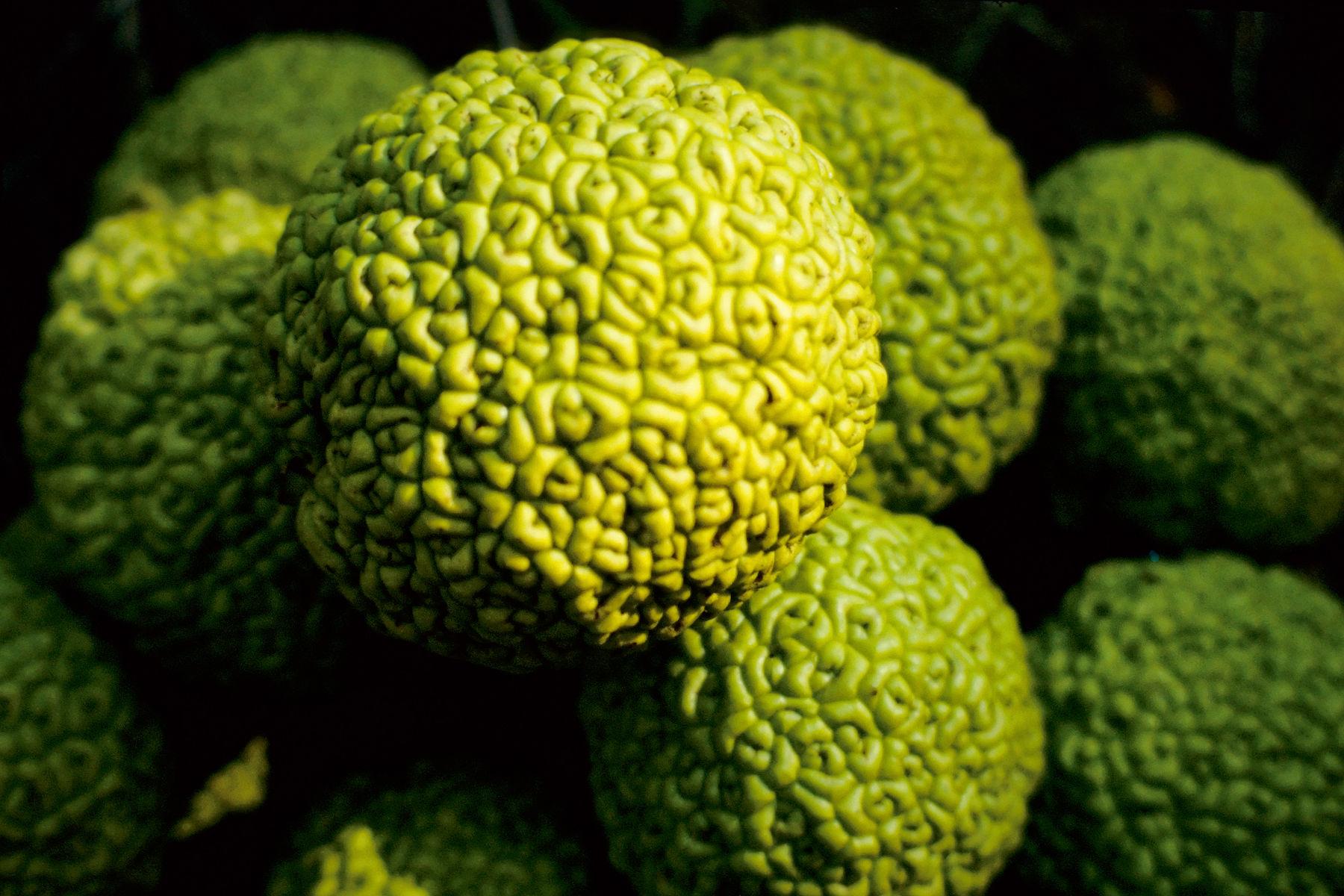
The next time you see one of those strange lime-green “horse apples” lying beneath a thorny Osage orange tree somewhere across the old Louisiana Purchase territories, take a second look.
You may be staring at one of the strangest intersections of Scripture, folklore, frontier engineering, Native American craftsmanship, constitutional expansion, and American identity ever rooted in the soil of the continent itself.