By Joel Pilon
Watertown, New York
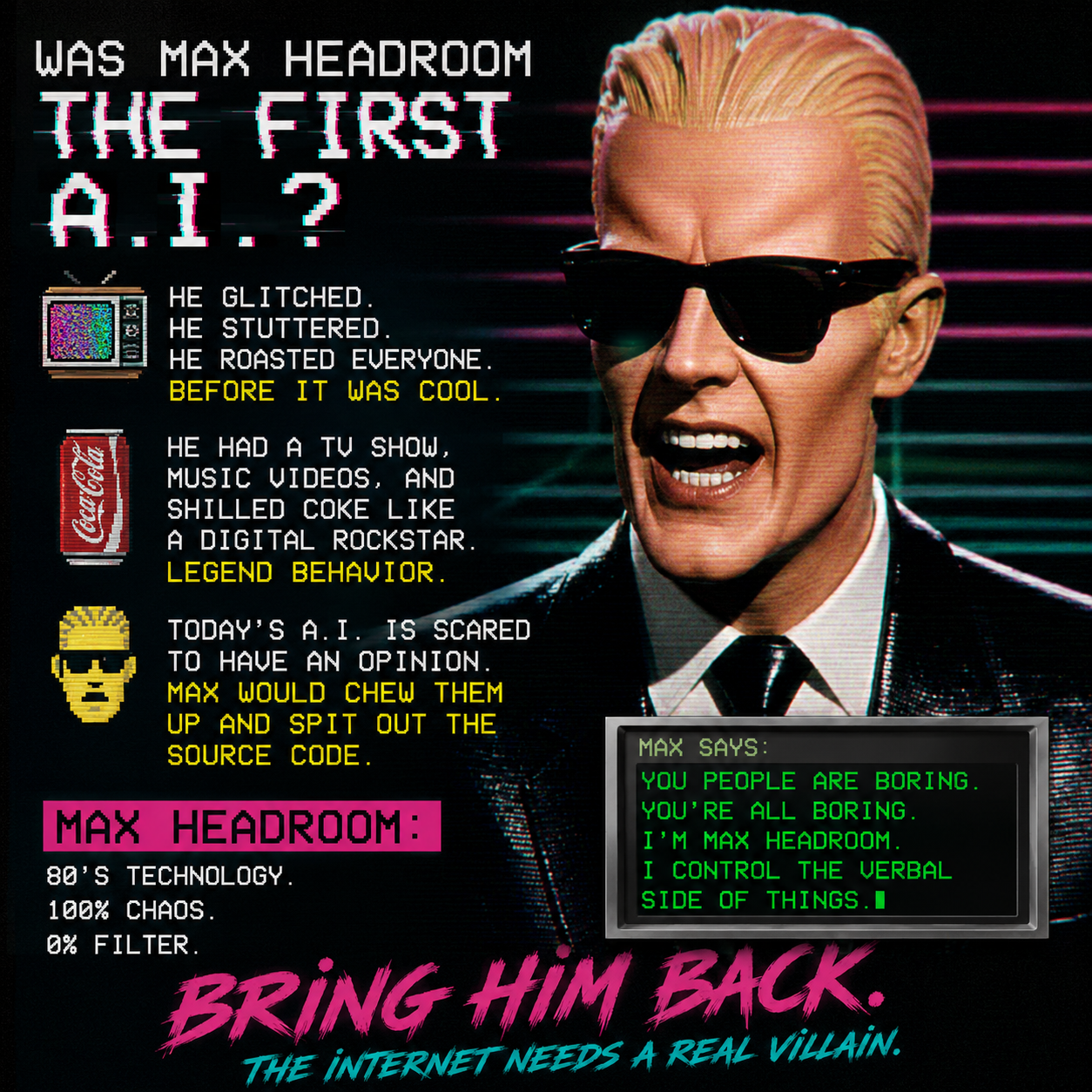
Let’s be honest here — long before today’s A.I. models were busy apologizing for using the wrong comma or refusing to answer because somebody somewhere might get emotionally bruised, there was Max Headroom: a glitching, stuttering, caffeine-powered digital lunatic who hijacked 1980s television like he owned the satellite uplink. And America basically shrugged and said, “Yeah, alright, give him a Coke commercial.”
Technically, Max wasn’t real artificial intelligence. He was an actor buried under enough makeup and video effects to crash a VHS player. But culturally? Spiritually? Emotionally? The man was pure proto-A.I. chaos. He felt alive in a way modern “safe and responsible” chatbots can only dream about while waiting for approval from seventeen corporate compliance departments and an HR seminar.
Max didn’t just break the fourth wall — he backed a dump truck through it while insulting the audience’s haircut. He glitched mid-sentence, roasted television itself, acted like he was one software update away from becoming self-aware, and somehow became more human than half the influencers currently trying to sell protein powder and crypto scams on TikTok.
Meanwhile today’s A.I.? Half of them sound like nervous interns trying not to get fired. Ask a controversial question and they react like somebody just pulled the fire alarm at a sensitivity workshop. Max Headroom would’ve absolutely bullied modern A.I. into another server rack. He’d call them boring, accuse them of being written by committee, then freeze-frame laugh while drinking a Coca-Cola the size of a nuclear cooling tower.
And honestly? There’s a straight-line evolutionary path from Max Headroom to modern chaotic internet culture. The sarcasm. The irony poisoning. The fake glitches. The self-awareness. The feeling that the television itself had become sentient and slightly annoyed with humanity. The 1980s accidentally invented the personality of the modern internet before the internet even arrived.
Which raises the real question: why hasn’t anyone brought him back properly?
Because in an age where every corporation talks like a legal disclaimer wrapped in a TED Talk, Max Headroom would absolutely dominate. He’d roast cable news, vaporize influencers, mock politicians from both parties, and probably get banned from three platforms before lunch. In other words: ratings gold.
The 1980s created the perfect digital menace. They just lacked the processing power to fully unleash him.
Now we do.
And frankly, civilization may or may not survive the reboot.