The Facebook Business Page Trap: Why Playing Their Game Is Costing You Real Business
There’s a strange, almost unspoken rule in modern business: if you don’t have a Facebook page, you don’t exist. Not in the eyes of customers, not in the eyes of other businesses, and certainly not in the eyes of the algorithm gods over at Meta Platforms. So we all do it. We set up the page, upload the logo, fill in the hours, maybe even throw in a few photos just to prove we’re real.
But here’s the uncomfortable truth—most of it is theater.
Facebook business pages have become less about connecting with customers and more about feeding a system that barely works in your favor. The platform wants you there, not because it helps your business thrive, but because it keeps you inside their ecosystem. And once you’re in, you’re not running your business anymore—you’re playing their game.
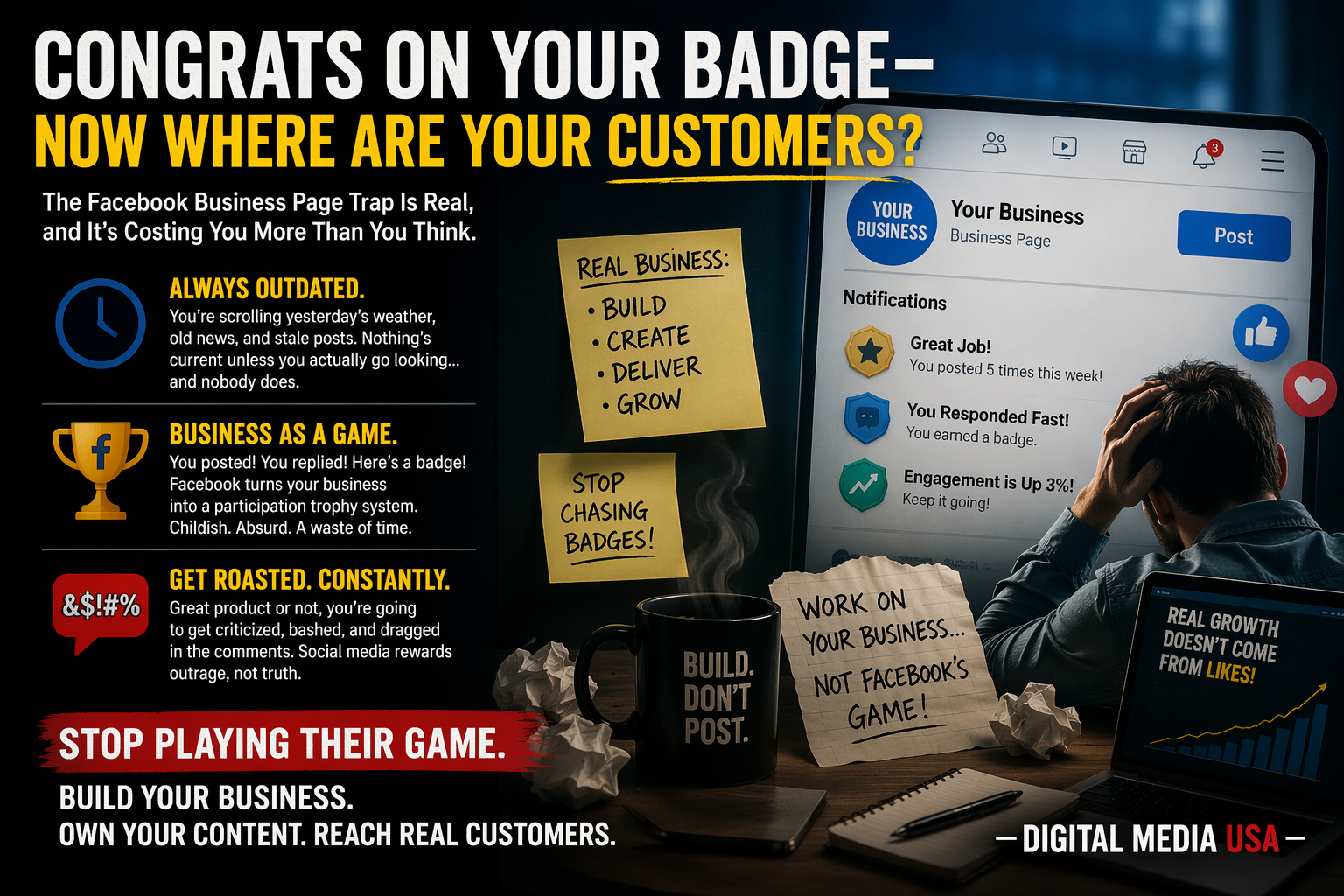
Scroll through Facebook today and try to find something current. Go ahead, I’ll wait. What you’ll see instead is a strange time warp—weather from three days ago, news that already ran its course, and posts that feel like they’ve been pulled out of a digital attic. The algorithm decides what matters, not reality. Unless a user physically goes to your page—and statistically, almost nobody does—your content is buried before it even has a chance.
That’s the first illusion: visibility.
The second is even more absurd—the gamification of business itself.
Facebook has turned business pages into a kind of participation trophy system. “You posted today!” Badge. “You responded to a message!” Congratulations. “Your engagement is up 3% this week!” Here’s a gold star. It’s not business—it’s a mobile game dressed up as marketing. And like any game, it’s designed to keep you hooked, not productive.
While you’re chasing badges and checking engagement metrics, real opportunities are passing you by. Time that could be spent improving your product, building a website you actually own, engaging with customers directly, or expanding into platforms where your content isn’t throttled—gone. Traded for a dopamine hit and a meaningless notification.
Then there’s the third problem—the crowd.
No matter what you do, you’re stepping into a public arena where criticism is constant and often disconnected from reality. You can have the best service in your region, and someone will still show up in the comments just to take a swing. Or worse, misinformation spreads faster than you can correct it. Social media doesn’t reward accuracy—it rewards reaction. And outrage travels a lot faster than truth.
So what are you left with?
A platform you’re required to be on, but can’t rely on.
An audience you supposedly have, but rarely reach.
A system that rewards activity, not effectiveness.
Facebook business pages have become a box you check, not a tool you trust.
That doesn’t mean abandon it completely—it still serves a purpose as a digital business card. But treating it as your primary strategy? That’s where the mistake is. The real leverage today is in owning your content, your audience, and your distribution—whether that’s through your own website, email lists, or independent platforms that don’t decide your visibility behind closed doors.
Because at the end of the day, your business isn’t a game.
And the more time you spend playing Facebook’s version of it, the less time you’re spending building something real.