-West Palm Beach / By Hans Wilder
Last night’s State of the Union wasn’t subtle. It wasn’t trimmed for cable news soundbites. It wasn’t calibrated for think-tank brunch panels in Georgetown.
It was a full-throated pitch for what President Trump repeatedly framed as America’s “Golden Age.”
And like it or not, it was disciplined.
For over an hour and a half, the message stayed on three pillars: sovereignty, strength, and self-confidence. Borders. Energy. Manufacturing. Law enforcement. Military readiness. Domestic production. You could summarize it as: America first, but said slowly and repeatedly so nobody could pretend they misheard it.
The Optics That Mattered
The emotional center of the speech wasn’t policy charts. It was people.
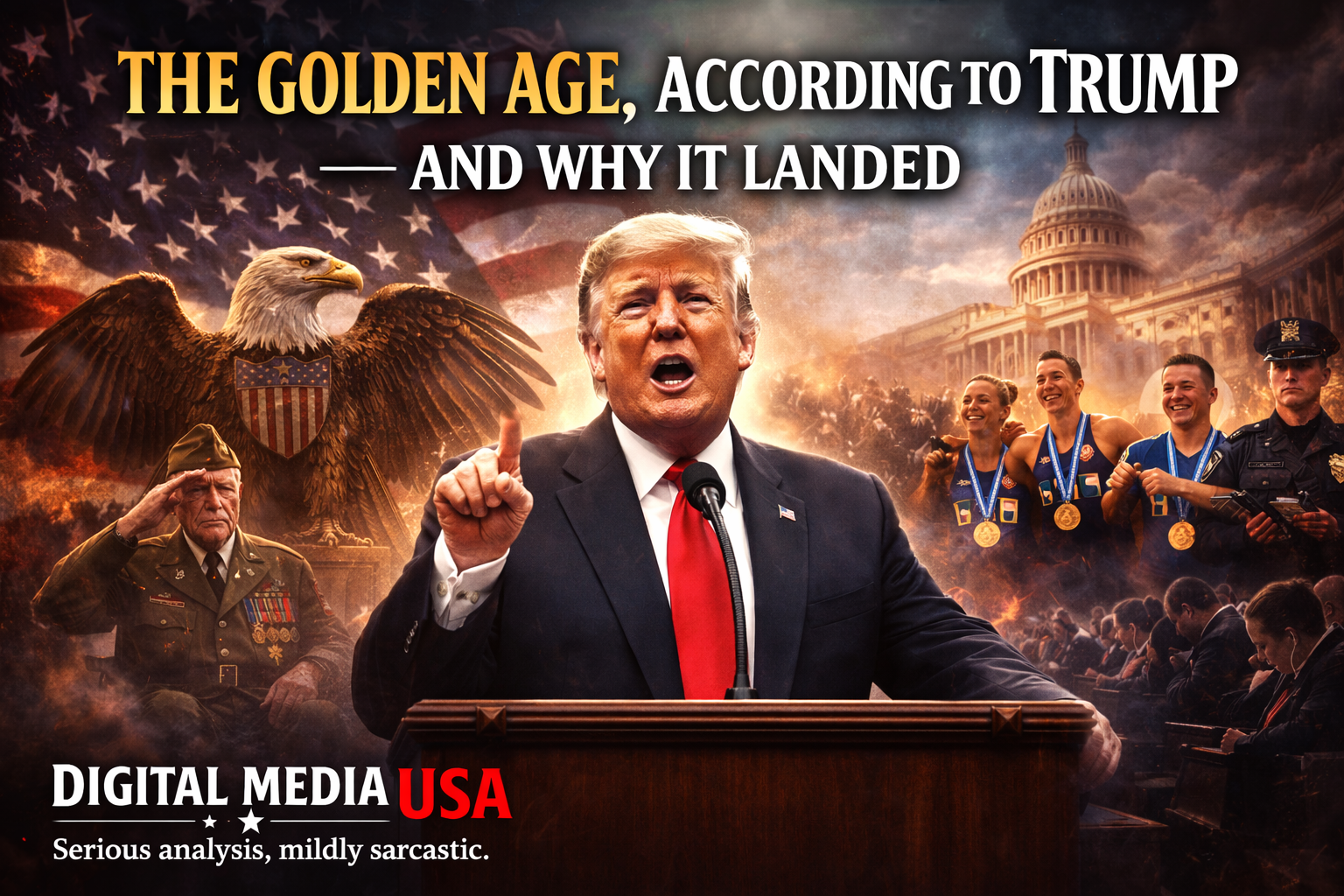
A 99-year-old World War II veteran.
A service member who rescued a child from deadly floods.
Families grieving violent loss.
Young Americans overcoming devastating obstacles.
Team USA gold medalists.
Law enforcement officers.
These weren’t abstract talking points. They were carefully chosen symbols of resilience, service, and national identity.
And here’s where the political tension became visible.
When some members of Congress declined to stand during certain tributes, it wasn’t just parliamentary choreography. It was television. And television is unforgiving. The split-screen writes its own commentary.
Trump understands visual politics better than most of his critics. He knows that a standing ovation frames unity. Remaining seated frames division. Whether fair or not, the optics were powerful.
The Policy Core: Energy, Borders, Industry
Underneath the emotion was a very clear economic thesis.
Trump argued that American prosperity depends on energy dominance — not apology. Drill, refine, export. The case presented was simple: cheap energy equals lower costs, stronger industry, and geopolitical leverage.
On border enforcement, the tone was equally direct. Secure the border first, debate the rest later. The administration framed the issue as a matter of order before ideology — sovereignty before sentiment.
Manufacturing was positioned as patriotic infrastructure. Bring production home. Incentivize domestic supply chains. Reduce dependency on rivals. The message was less about nostalgia and more about leverage.
Critics will call it protectionism. Supporters call it common sense.
The “Golden Age” Branding
The phrase “Golden Age” isn’t accidental. It’s branding. It evokes post-war growth, middle-class expansion, industrial dominance, and a sense that America was confident in its own trajectory.
It’s also aspirational. Because the present moment — inflation fatigue, geopolitical uncertainty, cultural fragmentation — doesn’t feel golden to most Americans.
Trump’s speech didn’t pretend everything is perfect. It argued that the fix is strength, not retreat. Expansion, not contraction. Assertiveness, not apology.
You may disagree with the methods. But the direction was unmistakable.
The Political Divide Is Now the Story
If the speech proved anything, it’s that the divide in Washington isn’t procedural — it’s philosophical.
One vision centers on national cohesion built around borders, industry, law enforcement, and traditional patriotism. The other emphasizes global cooperation, regulatory frameworks, and social restructuring.
Neither side believes the other is merely mistaken. Each believes the other is dangerous.
That’s not a healthy dynamic.
But it is the reality.
Why It Resonated
For voters who feel ignored by coastal institutions, the speech likely felt validating. For those who prioritize national strength over diplomatic delicacy, it felt clarifying.
Trump did not attempt to soften edges for universal applause. He sharpened them.
And in modern politics, clarity often beats consensus.
The question moving forward isn’t whether the speech energized his base. It did.
The question is whether the promise of a “Golden Age” feels attainable enough — and tangible enough — to expand beyond it.
Because branding alone doesn’t build prosperity.
But confidence, direction, and execution sometimes do.
Digital Media USA
Serious analysis, mildly sarcastic.