The Smart Money Is Betting on Anthony Constantino — and NY-21 May Be the First Sign of a Bigger Political Realignment
In most congressional primaries, the signals are familiar and often stale: internal polls, consultant spin, donor whispers, and carefully staged endorsements. But in New York’s 21st Congressional District, something different is happening — and it’s unfolding in real time, with actual money on the line.
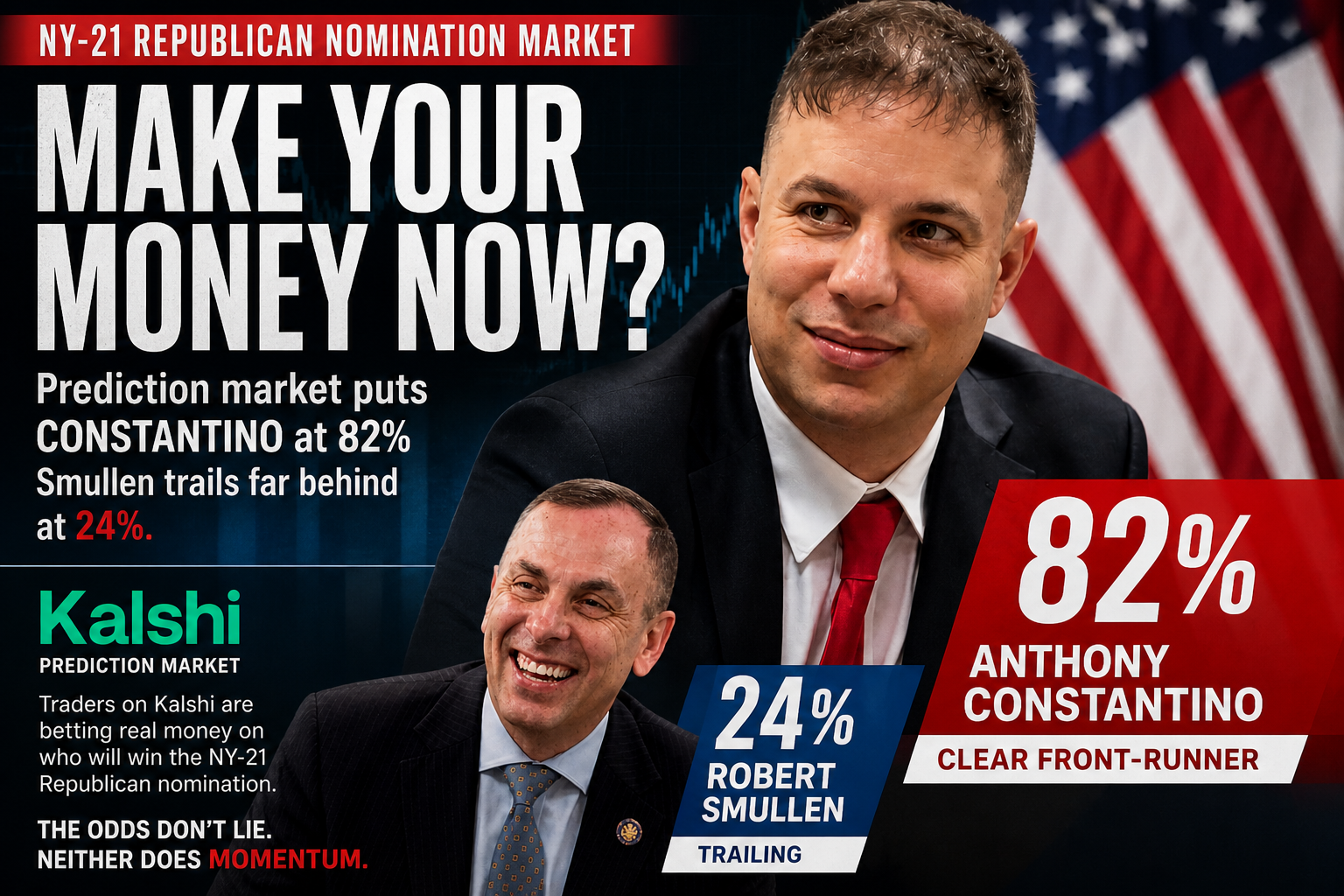
A prediction market operated by Kalshi has opened trading on the Republican primary, and the early verdict is not subtle. Traders have priced Anthony Constantino at roughly 82 percent to secure the nomination, leaving his opponent, Robert Smullen, trailing significantly behind.
This isn’t polling. It’s not a focus group. It’s a live market — people risking capital based on what they believe will actually happen.
And right now, the market is overwhelmingly aligned behind Constantino.
That distinction matters.
Prediction markets have long been viewed as a more honest barometer than traditional polling, precisely because they strip away the incentives to mislead. There is no reputational hedge here. No partisan weighting. No “likely voter” modeling. Participants either read the field correctly — or they lose money.
In that sense, NY-21 is becoming more than a regional race. It’s turning into a test case for how political momentum is forming in a post-consultant, post-media-filter environment.
Constantino’s rise fits a pattern that is beginning to show up across the country. A self-funded candidate. A business builder rather than a career officeholder. A campaign message rooted less in political language and more in economic outcomes: jobs, growth, cost of living, and control over personal income.
He also carries the backing of Donald Trump, an endorsement that still carries significant weight in Republican primaries. But the market signal suggests something beyond endorsement politics. Traders appear to be responding to a broader alignment — a candidate who combines financial independence, recognizable brand presence, and a message calibrated to economic frustration rather than ideological abstraction.
In contrast, Smullen represents a more traditional pathway: legislative experience, institutional familiarity, and a campaign model built on established political structures. In another cycle, that might have been the safer bet.
But this is not a typical cycle.
Across multiple states, there is growing evidence that voters — and increasingly, those betting on voters — are gravitating toward candidates who operate outside conventional political frameworks. The appeal is straightforward: fewer intermediaries, fewer obligations, and a clearer line between campaign promises and personal accountability.
Markets tend to notice these shifts early.
What makes NY-21 particularly interesting is how visible the divergence has become. An 82-to-24 split in a live trading environment is not a narrow edge. It’s a statement. It suggests that, at least among those willing to wager on the outcome, the race is not viewed as especially competitive at this stage.
Of course, markets are not infallible. They move. They react. They correct.
But they also reveal conviction in a way that polls rarely do.
And right now, the conviction is clear: Anthony Constantino is not just leading — he’s being treated as the outcome.
If that holds, the implications extend well beyond Northern New York. A decisive win by a self-funded, business-first candidate backed by market confidence would reinforce a growing narrative inside Republican politics — that the next wave of candidates may look less like politicians and more like operators.
In that sense, NY-21 is not just a primary.
It’s a signal.
And the people putting their money down appear to believe they’re seeing the future early.