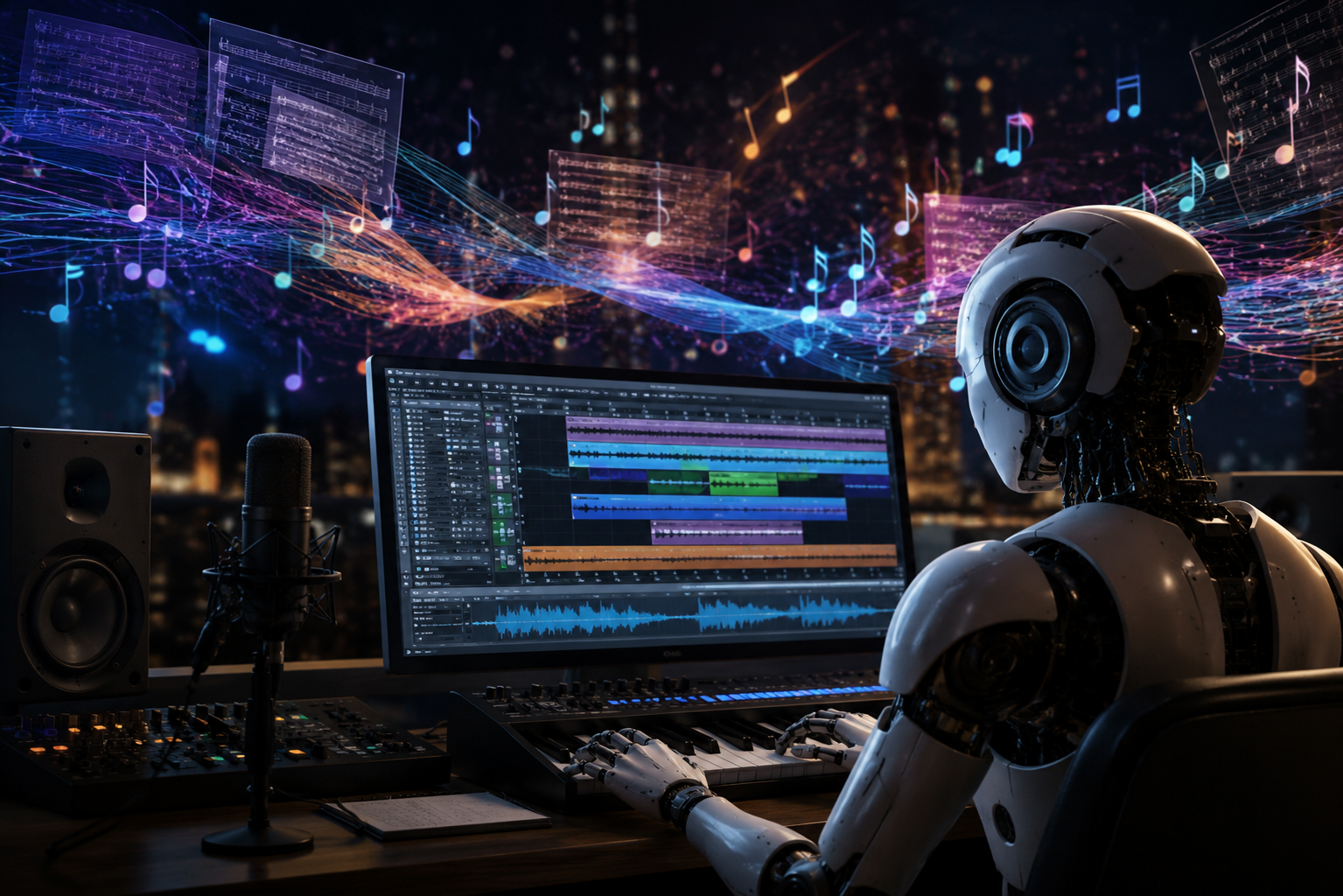
Somewhere right now, at 3:17 in the morning, a guy in sweatpants sitting in a dark room with a glowing monitor is typing the words:
“1970s smoky lounge singer with heartbreak vibes, soft trumpet, lonely highway atmosphere.”
Ten seconds later, a fully produced song appears out of thin air.
No drummer.
No guitar player.
No studio session.
No expensive microphones.
No producer screaming through glass about the tempo being off by two beats per minute.
Just machines.
And according to Deezer, the machines are now uploading nearly 75,000 fully AI-generated songs every single day — representing roughly 44% of all new uploads hitting the platform.
That number alone should make the entire music industry sit upright in its chair and slowly remove its sunglasses.
Because this is no longer some weird experimental side project cooked up by Silicon Valley coders and basement hobbyists.
This is industrial-scale music production.
And whether people like it or not, the economics behind it are brutally obvious.
For years, streaming platforms quietly trained audiences to consume music differently. People no longer necessarily search for bands. They search for moods. They search for “deep focus jazz,” “dark country highway music,” “rain sounds with soft piano,” “epic western soundtrack,” “coffeehouse ambience,” or “retro lounge music for driving through a neon city at night.”
The playlist became more important than the artist.
That subtle cultural shift opened the door wide open for AI music generation.
Because if a listener only wants a vibe, the system doesn’t necessarily care whether the creator spent twenty years mastering guitar scales in Nashville or typed six words into a software prompt while eating cold pizza in Buffalo.
And in all fairness, here at Digital Media USA, we understand exactly why this explosion is happening. We operate several YouTube music channels ourselves, including spaghetti western music and 1960s and 1970s-style lounge music channels that have generated millions of views collectively.
We’ve watched the audience behavior firsthand.
People stream this material for hours while working, relaxing, gaming, driving, editing videos, writing code, studying, or simply attempting to maintain psychological stability while doomscrolling through modern civilization.
The demand for atmospheric music is almost endless.
AI simply arrived with an infinite supply.
Platforms like YouTube, Spotify, and Apple Music reward volume, consistency, and algorithmic engagement. The more content uploaded, the more chances there are to hit recommendation systems and playlists.
That means creators using AI tools can now generate entire catalogs in days that once would have taken years.
Need fifty vintage surf-rock tracks?
Done.
Need a hundred fake 1974 detective-show jazz instrumentals?
Done.
Need haunting desert guitar music that sounds like it came from an Italian western nobody remembers?
Done.
The speed is honestly staggering.
Tools like Suno and Udio have lowered the barrier to entry so dramatically that virtually anyone with a laptop and imagination can now create full songs with vocals, instrumentation, mixing, and mastering in minutes.
And yes, people are making real money doing this.
Streaming royalties may not make creators rich individually, but scale changes the equation. A creator with thousands of tracks spread across multiple platforms, YouTube channels, ambient streams, playlists, and background-music libraries can absolutely generate revenue. Some are monetizing through YouTube ads. Others license AI music for podcasts, videos, games, or businesses looking for royalty-free soundtracks.
The old music industry relied heavily on scarcity.
AI runs on abundance.
That difference changes everything.
Of course, this is where musicians begin grinding their teeth.
Because many artists spent decades learning instruments, touring in broken vans, living in cheap apartments, recording demos, and trying to perfect a craft that can now be simulated frighteningly well by software.
And to make matters worse, average listeners often cannot tell the difference anymore.
One recent survey tied to Deezer found that most participants failed to reliably distinguish AI-generated music from human-created songs during blind listening tests.
That statistic alone should terrify record labels.
Because once the average consumer stops caring how music is made, the business model fundamentally changes.
The streaming companies know this.
The tech companies definitely know this.
And Wall Street knows this.
Which is why the floodgates are opening.
But underneath all the excitement sits a darker reality few people are talking about publicly.
A substantial portion of this AI music boom appears tied to spam operations and streaming fraud. Deezer recently reported that the majority of detected AI-generated streaming activity connected to certain uploads appeared fraudulent in nature.
In plain English?
Some of these systems may literally consist of bots listening to AI-generated songs uploaded by other bots in order to generate artificial streaming revenue.
Machines producing music for machines.
It sounds absurd until you remember the modern internet already runs on fake clicks, fake followers, fake engagement, fake reviews, fake traffic, and fake outrage.
Why wouldn’t fake music streams eventually join the party?
Meanwhile, the legal chaos is only beginning.
Major record companies are now battling AI firms over copyright questions involving training data, artist imitation, voice cloning, and ownership rights. If an AI studies thousands of songs from famous artists and then generates something “inspired” by them, who owns the result? The software company? The user? The original artists? Nobody seems entirely sure yet.
And governments are moving far slower than the technology itself.
By the time regulations arrive, the landscape may already be unrecognizable.
Still, despite the panic spreading throughout parts of the music industry, there’s another side to this story people should acknowledge honestly.
AI music is democratizing creativity in ways that were impossible only a few years ago.
A kid in rural America with no studio, no band, no industry connections, and no money can now create cinematic music, publish it globally, and potentially reach millions of listeners.
That reality matters too.
Not everybody using AI music tools is a scammer or spammer.
Some are genuine creatives experimenting with entirely new forms of production.
Others are filmmakers, storytellers, independent game developers, podcasters, or artists trying to bring ideas to life without massive budgets.
The technology itself is neither good nor evil.
It’s a tool.
The same argument happened when synthesizers appeared. Then drum machines. Then sampling. Then digital recording. Then autotune.
Every generation believes the next technological shift is “the death of real music.”
And yet music survives.
It mutates.
It evolves.
It absorbs the new technology and keeps moving.
The real question now is whether audiences will continue valuing authentic human artistry once perfectly customized music can be generated instantly for every mood, every occasion, and every emotional state imaginable.
Because once AI can create a heartbreak song specifically tuned to your personality, your age, your memories, your preferred instruments, your emotional profile, and your listening history…
…the line between art and algorithm starts getting very blurry indeed.
This music below is an example of modern AI-generated audio created using artificial intelligence music software. No traditional band, recording studio, or live musicians were involved in the production process. The track was generated through machine learning systems capable of creating full songs, vocals, instrumentation, and atmosphere from simple prompts and stylistic instructions.