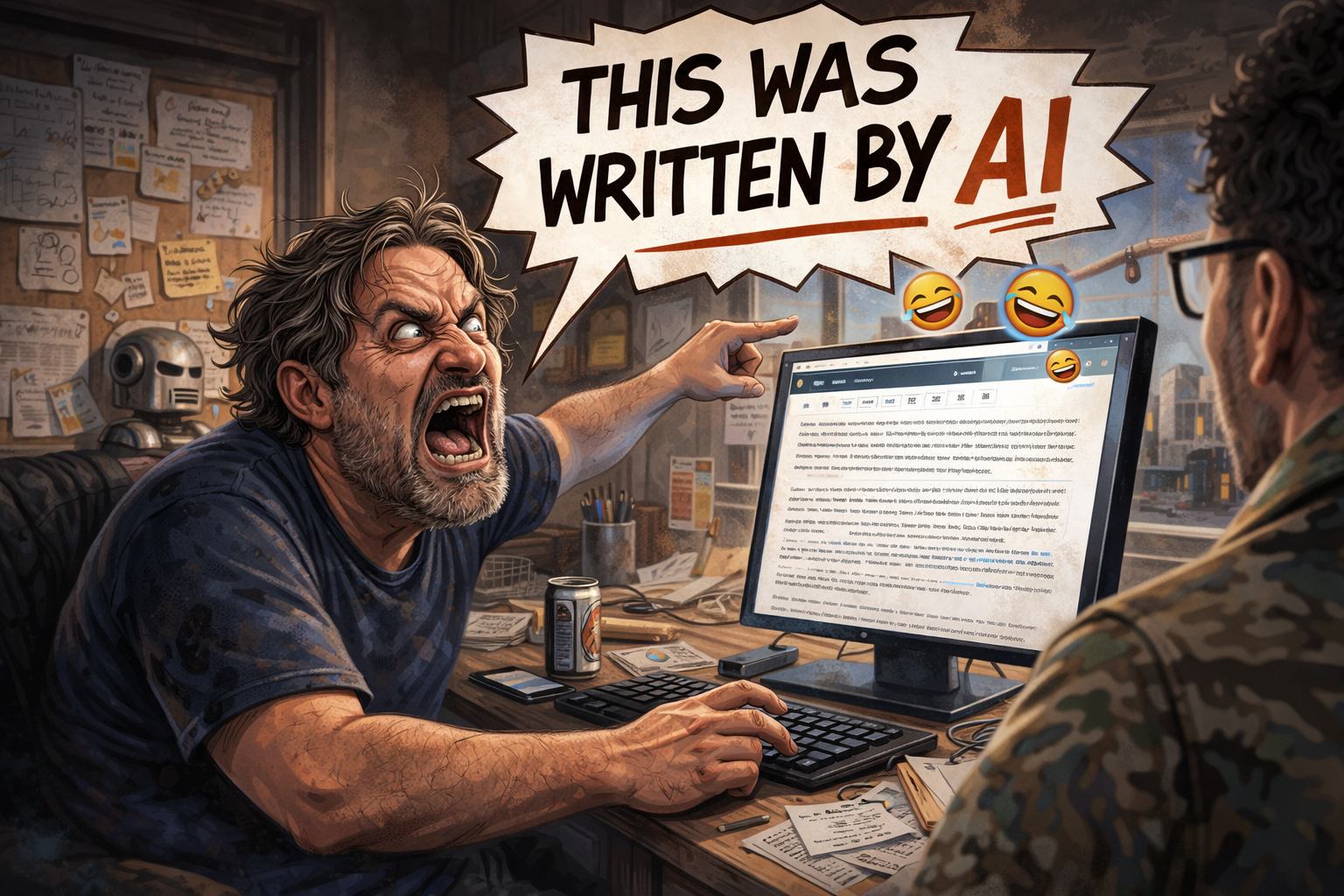
There is a new species roaming the comment sections of America.
He doesn’t debate the argument.
He doesn’t question the facts.
He doesn’t even finish reading.
He squints at a paragraph and declares, like a digital bloodhound:
“This is AI.”
Sometimes he adds “slop.”
Sometimes he adds three laughing emojis.
Sometimes he types it like he just caught you shoplifting a toaster.
What’s going on here psychologically?
Let’s examine our modern Sherlock Holmes of Syntax.
1. The Authenticity Panic
We are living through what psychologists might politely call an authenticity crisis.
People are afraid that nothing is real anymore. Photos are filtered. Videos are edited. Politicians are scripted. Now even paragraphs can be manufactured.
When someone yells “AI!”, they’re not just critiquing writing style. They’re defending the last sacred territory: human expression.
It’s less about grammar.
It’s more about identity.
If a machine can produce coherent arguments, what exactly is Kevin bringing to the table besides a keyboard and confidence?
2. Status Protection
Let’s be honest. Writing used to be impressive.
You could type a structured paragraph, use a semicolon correctly, and suddenly you were “articulate.” That came with status.
Now software can draft cleaner prose than the average comment section philosopher. That threatens hierarchy.
So pointing out AI use becomes a status move.
It says:
- “I detect the machine.”
- “I am still the craftsman.”
- “This doesn’t count.”
It’s intellectual gatekeeping in sweatpants.
3. The Effort Myth
There is a deeply ingrained belief that effort equals worth.
If you sweat over a paragraph for an hour, it feels valuable.
If someone produces similar quality in three minutes using tools, it feels like cheating.
But here’s the uncomfortable truth: society has always replaced effort with efficiency.
Calculators replaced long division.
Word processors replaced typewriters.
Spellcheck replaced dictionary flips.
Nobody yells “YOU USED A CALCULATOR!” during tax season.
But with AI, people feel the shift more personally — because this tool doesn’t just automate math. It automates expression.
That hits closer to the ego.
4. Pattern Hunters on Patrol
There’s also a cognitive component.
Humans love detecting patterns. Once someone decides AI writing has a “tone,” they start spotting it everywhere.
Slightly structured paragraphs? AI.
Clear transitions? AI.
No spelling errors? Definitely AI.
Ironically, the accusation often says more about the accuser’s expectations than the text itself.
If you’re used to chaos, coherence looks suspicious.
5. The Fear of Obsolescence
Let’s drop the comedy for a second.
Underneath a lot of AI-calling-out behavior is anxiety.
If machines can:
- Write articles
- Generate images
- Draft emails
- Outline arguments
What happens to the human who built identity around those skills?
Calling something “AI” can be a way of distancing oneself from that threat.
“If it’s machine-made, it doesn’t count.”
It’s a psychological defense mechanism. Shrink the threat, preserve the self.
6. Moral Framing
Some critics frame AI use as inherently unethical, lazy, or deceptive.
That moral angle provides comfort. It converts technological disruption into a virtue battle.
It’s easier to say, “I refuse to use it because I have integrity,” than to admit, “I’m not sure where I fit in this new landscape.”
Technology shifts are rarely resisted with spreadsheets. They’re resisted with morality.
7. The Irony No One Mentions
Most of the people shouting “AI!” are doing it on platforms run by AI.
Your feed is curated by machine learning.
Your ads are targeted by machine learning.
Your content visibility is decided by machine learning.
But the paragraph is where we draw the ethical line?
That’s like protesting electricity using a megaphone.
So What’s the Real Driver?
It’s not really about the paragraph.
It’s about:
- Authenticity anxiety
- Status preservation
- Fear of irrelevance
- Loss of uniqueness
- Rapid technological change
We are watching identity renegotiate itself in real time.
Some people adapt.
Some people accuse.
Some people do both.
Here’s the uncomfortable reality:
Tools do not eliminate human thought. They amplify it — badly or brilliantly depending on the operator.
If someone uses AI poorly, you’ll know.
If someone uses it well, you might just think they’re a better writer.
And that, perhaps, is what bothers the loudest critics the most.
Now if you’ll excuse us, we’re going to go sharpen our quill pens and feed the typewriter coal.
Just to keep it authentic.