Watertown NY By Hans Wilder
I’ve never believed cats are just pets. I think they’re souls. Not human souls trapped in cat bodies, but cat souls—running their own mysterious software on the same universe that produced us. Different creatures. Different instincts. Different purposes. Yet somehow, we’ve been sharing the same neighborhoods for thousands of years.
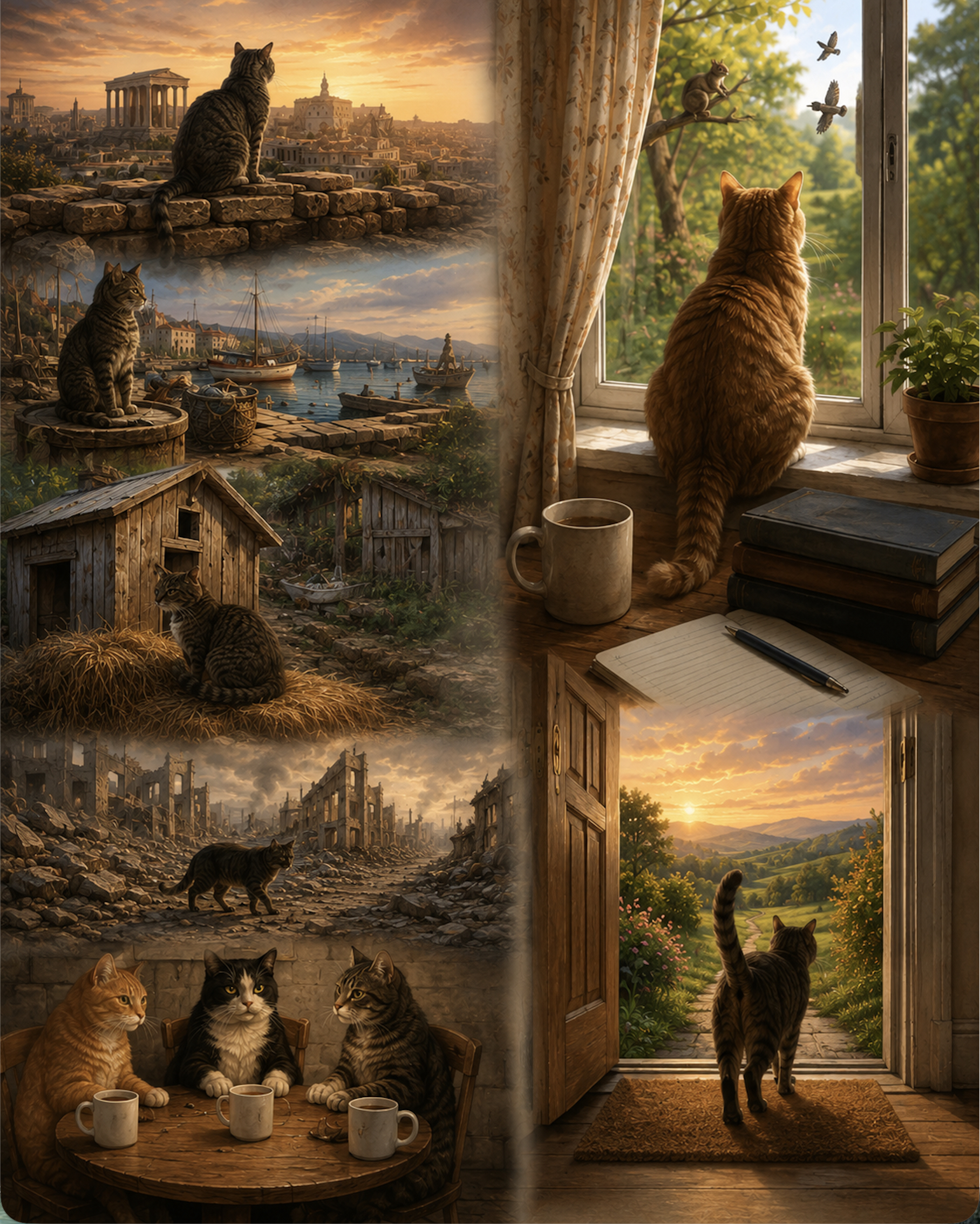
Long before there were suburbs, litter boxes, or laser pointers, there were cats. They wandered through ancient cities, fishing villages, castles, monasteries, farms, ship decks, dusty alleyways, and even the rubble left behind after wars. Wherever human civilization took root, cats eventually appeared—not because we owned them, but because they decided we were worth hanging around. We accidentally built a world with mice, warm fires, dry barns, and the occasional sucker willing to open a can of tuna.
Somewhere along the way, a few of them decided to move into our houses. Notice I said decided. I don’t think cats see themselves as possessions. I think they see themselves as roommates with unusually generous staff.
A cat can spend years sitting in a sunny window like an old philosopher. Birds flutter through the yard. Squirrels dart across the fence. Leaves dance across the lawn. Another neighborhood cat strolls confidently down the sidewalk. You can almost hear the gears turning as your cat watches it all. In my mind, he’s thinking, “So… that’s what they’ve all been talking about.”
Then one day someone leaves the front door open for three seconds too long.
Humans call it an escape.
The cat calls it an expedition.
He’s spent years being the observer, safely watching the world through glass. Suddenly the universe offers him a choice: keep watching, or become part of the story. Every cat already knows the answer. Tail in the air, ears forward, he steps outside convinced he’s the first explorer ever to discover the backyard.
I’ve shared my life with several cats over the years. Some became experts at living in both worlds. They’d disappear into the woods, patrol the neighborhood, conduct whatever mysterious diplomatic business cats conduct after dark, then stroll home exactly at dinnertime wearing the expression of someone who had just negotiated an international peace treaty. They lived long, healthy lives.
Others weren’t as fortunate.
That’s where what I call the mathematics of life enters the equation.
I’ve always believed the universe is built on mathematics, whether we understand it or not. Every living thing is part of that calculation—a mouse, a hawk, a deer, a human, a cat. Probability. Timing. Weather. Disease. Predators. Automobiles. Pure luck. Millions of tiny variables intersect every second of every day, producing outcomes none of us can fully predict.
Sometimes those equations give us twenty wonderful years with a cat curled up on the same windowsill every afternoon. Sometimes they don’t.
The mathematics isn’t cruel. It isn’t compassionate. It simply is.
I’ve never blamed a cat for choosing to be a cat any more than I’d blame a robin for flying south or a trout for swimming upstream. Every living thing is solving life’s equation with the information available to it. None of us gets to see the whole formula.
That idea has always reminded me of Schrödinger’s famous thought experiment. In quantum physics, the cat in the box represents a strange mathematical description of reality before an observation is made. The experiment isn’t really about cats at all. It’s about uncertainty and the peculiar way the quantum world works.
Still, I’ve often imagined what an actual cat would think of the whole thing.
A real cat wouldn’t sit quietly inside a box waiting for physicists to argue about probability. It would spend the first five minutes figuring out how to escape, the next ten knocking something off a shelf, and then somehow convince everyone it wasn’t responsible.
Maybe that’s because cats don’t spend their lives obsessing over every possible future. Humans constantly ask, “What if?” Cats ask only one question:
“What’s over there?”
Cats are going to be cats, and humans are going to be humans.
Humans have some pretty strong opinions about cats. Some people simply don’t like them. Every paw print becomes a federal investigation. Every meow is treated like a noise ordinance violation. Every cat crossing a lawn is somehow committing a personal offense. Cats, meanwhile, remain blissfully unaware that they’re violating neighborhood politics.
Then there are those who devote their lives to rescuing and protecting cats. I respect that deeply. They’ve saved countless animals that otherwise wouldn’t have had a chance. But sometimes I think we humans convince ourselves there’s only one philosophy that fits every cat.
Some believe every cat should spend every minute indoors because it’s unquestionably the safest life. I understand that argument. I really do.
But I also understand the cat.
Some cats are perfectly happy living their entire lives on a couch, moving occasionally to the windowsill just to supervise the birds. Others spend every afternoon staring through that same window with adventure written across their face. They’re not trying to leave because they hate home. They’re answering something far older than walls, fences, or civilization itself.
For thousands of years, cats have walked beside humanity without ever completely belonging to it. I’ve always believed every cat is an individual. Just as people value making their own choices, I think cats do too—in their own feline way. Freedom has always involved risk. So has curiosity. So has living. If we eliminated every possible danger from life, we’d eventually eliminate much of what makes life worth experiencing.
Personally, I’m convinced cats hold meetings about us when we’re asleep.
“Human Number Three attempted to pet me seventeen times today. His hunting abilities remain disappointing.”
“Mine stared into a glowing rectangle for eight consecutive hours and somehow believes I’m the strange one.”
Maybe that’s why I’ve always admired them.
Cats don’t pretend to be anything they’re not. They don’t ask permission to exist. They don’t care about popularity contests, internet debates, or whether somebody approves of the way they live. They simply wake up every morning and become completely, unapologetically… cats.
Perhaps that’s what they’ve been quietly teaching humanity all along. Not that every adventure ends happily. Not that every choice is safe. Not that the mathematics of life will always work in our favor. But that every soul—whether it walks on two legs or four—eventually looks through a doorway, wonders what’s over the next hill, and has to decide whether to remain the observer… or become part of the story.
Maybe that’s why cats have stayed beside us for thousands of years. They’re not just living with us.
They’re reminding us what it means to be alive.
And finally, to the lady who scolded me this weekend because my cat was outside: lighten up.
You told me that if I really loved my cat, I’d never let him leave the house because the world is full of danger. I understand your concern, but by that logic maybe we should all drive two miles an hour because it’s safer. Maybe we should never let our kids climb a tree, ride a bicycle, or play outside. Maybe we should spend our entire lives trying to eliminate every possible risk.
That’s not living.
That’s existing.
Every one of us, whether we walk on two legs or four, lives somewhere between safety and freedom. I love my cat enough to feed him, care for him, take him to the veterinarian, and worry about him when he’s late coming home. I also love him enough to remember that he’s a cat, not a piece of furniture.
We all make choices, and eventually the mathematics of life catches up with every living thing.
Until then, I’ll let my cat be a cat.
And maybe you can let people have different philosophies without assuming yours is the only one that comes from love.