LAKE PLACID, N.Y. — By Hans Wilder
There was a time when becoming a news organization required something more than a domain name, a content management system, and the ability to copy and paste links. A newsroom was exactly that—a room full of reporters. They attended meetings, cultivated sources, filed Freedom of Information requests, interviewed witnesses, checked facts, and occasionally made both political parties equally angry. It wasn’t glamorous, but it was journalism. Today, however, a growing number of digital publications have discovered there is another way to build an audience: let somebody else do the expensive reporting while you become the place where everyone goes to find it.
There is nothing inherently wrong with aggregation. In fact, it serves an important purpose. The Drudge Report built one of the most influential political websites in America by pointing readers toward stories reported by other organizations. It never pretended to be a newsroom in the traditional sense. It was a traffic director, and everyone understood the arrangement. The original reporters received credit for their work, and readers knew exactly where the reporting originated. That is an honest business model.
Unfortunately, a new hybrid model has emerged across the country, and it has quietly muddied the waters. These websites sprinkle their own content among links to stories produced by newspapers, television stations, and other media organizations until the entire presentation begins to look like one seamless news product. To the average reader, everything appears to come from one source, even when much of the reporting was done elsewhere. The result is a digital shell game in which the headline gets remembered, the website gets remembered, but the newsroom that actually uncovered the story slowly disappears from public memory.
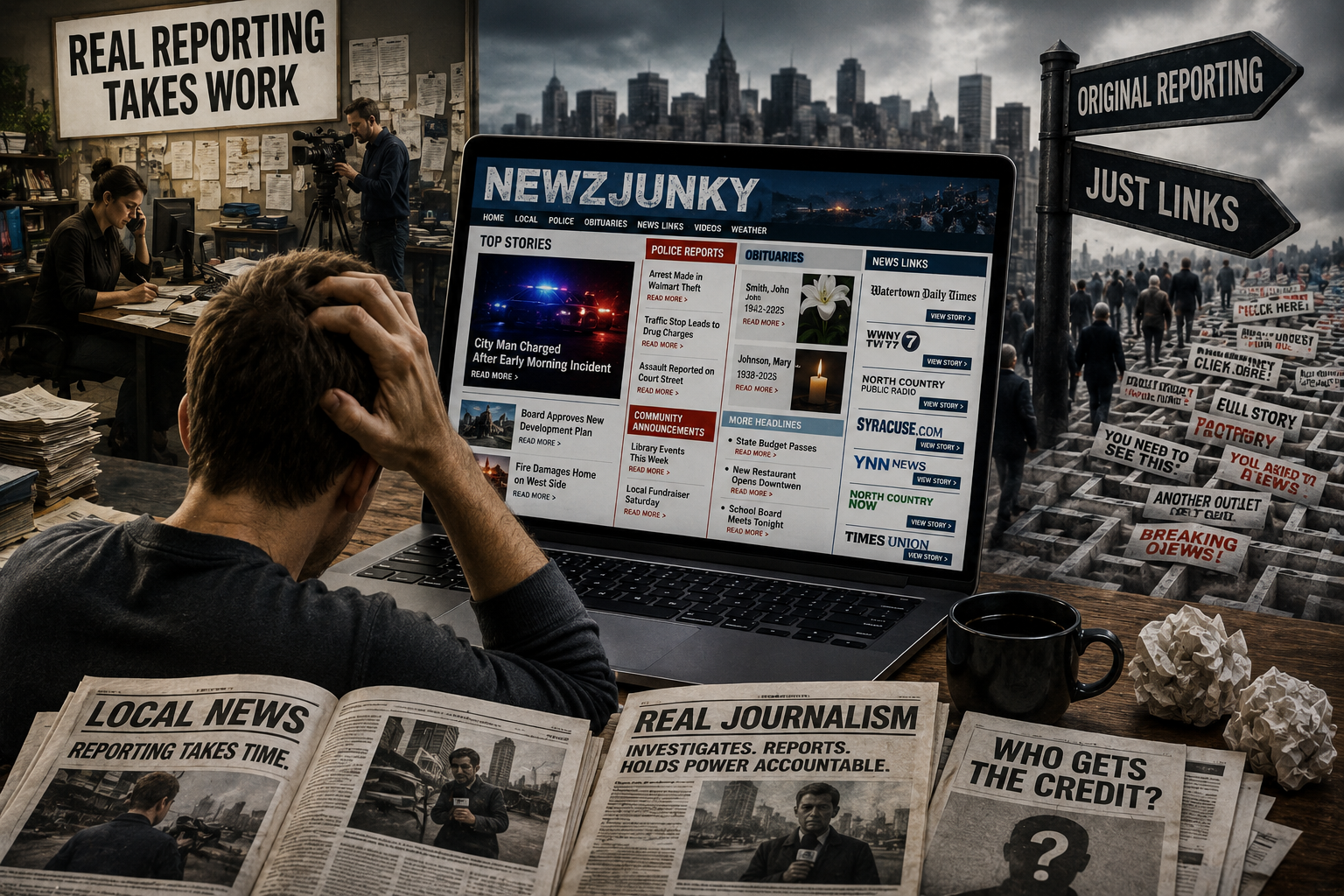
Northern New York offers an excellent example of this national trend in the form of Newzjunky. The site has built a loyal following by collecting regional headlines alongside police reports, public notices, obituaries, and its own original content. There is no question that it is convenient. Convenience, however, should never be confused with journalism. A grocery store is convenient too, but nobody walks out believing the cashier grew the tomatoes.
The ethical question isn’t whether Newzjunky has the right to link to other organizations. Of course it does. Every website on Earth links to something. The question is whether readers can immediately and unmistakably determine who actually reported the story they are looking at. In my opinion, that distinction has become increasingly blurred, and when that happens, journalism itself begins to lose its identity. A reporter who spent two days investigating a story deserves more than becoming an anonymous supplier to someone else’s homepage.
The economics behind this trend are hardly mysterious. Original reporting is expensive. Good reporters expect salaries. Cameras, photographers, editors, lawyers, public records requests, travel expenses, and investigative projects all cost money. Collecting links, on the other hand, costs almost nothing by comparison. The internet has created a business environment where becoming known as the place that has the news can sometimes be more profitable than becoming the organization that reports the news. That’s a remarkable shift, and not necessarily a healthy one.
Readers pay the price in more ways than one. Click a headline and you often land at a subscription page. Click another and you’re asked to create an account. Click a third and you’re staring at yet another paywall. Before long, the experience feels less like visiting a newsroom and more like wandering through a shopping mall where every storefront is asking for your credit card. If the goal is to inform the public, sending readers on an obstacle course of subscriptions seems like a peculiar way to accomplish it.
Then there is the visual clutter that has become almost standard across hybrid news websites. Police reports compete with advertisements. Breaking news shares space with community announcements. External links sit beside original content, while obituaries quietly remind everyone before breakfast that mortality remains undefeated. Somewhere in the middle of that digital yard sale is the story you were actually trying to read. Good luck finding it without a GPS and a cup of strong coffee.
What concerns me most is that this phenomenon extends far beyond one website in Northern New York. Radio hosts routinely cite aggregators as though they broke the story. Social media users share the aggregator’s link without ever mentioning the publication that performed the reporting. Public officials reference the website where they found the headline rather than the newsroom that invested the time and resources to uncover the facts. Little by little, journalism’s credit is reassigned to the middleman.
That should concern anyone who values a free press. If the organizations investing in investigative reporting no longer receive the recognition that sustains their reputation and business model, fewer organizations will make those investments. Investigative journalism doesn’t disappear overnight. It simply becomes harder to justify financially while aggregation becomes increasingly attractive. Eventually, everyone wonders why nobody is digging for the truth anymore, forgetting that we’ve spent years rewarding the websites that collected the shovel instead of the people who actually dug the hole.
This is not an argument against aggregation. It is an argument for transparency. Readers should never have to guess who attended the meeting, interviewed the source, verified the facts, or spent days chasing a story. That information should be obvious the moment they see the headline. Journalism depends upon attribution in much the same way science depends upon citations. Remove either one, and credibility begins to erode.
Newzjunky is not the disease. It is simply a symptom of a much larger transformation taking place throughout American media. The internet has made it remarkably easy to become known as a news destination without carrying the full burden of being a newsroom. That may be an efficient business model, but it also raises an uncomfortable question that every reader should begin asking before clicking the next headline.
Who actually did the work?
Because if we stop caring about the answer, we shouldn’t be surprised when fewer people are willing to do it.