– Watertown NY By Hans Wilder
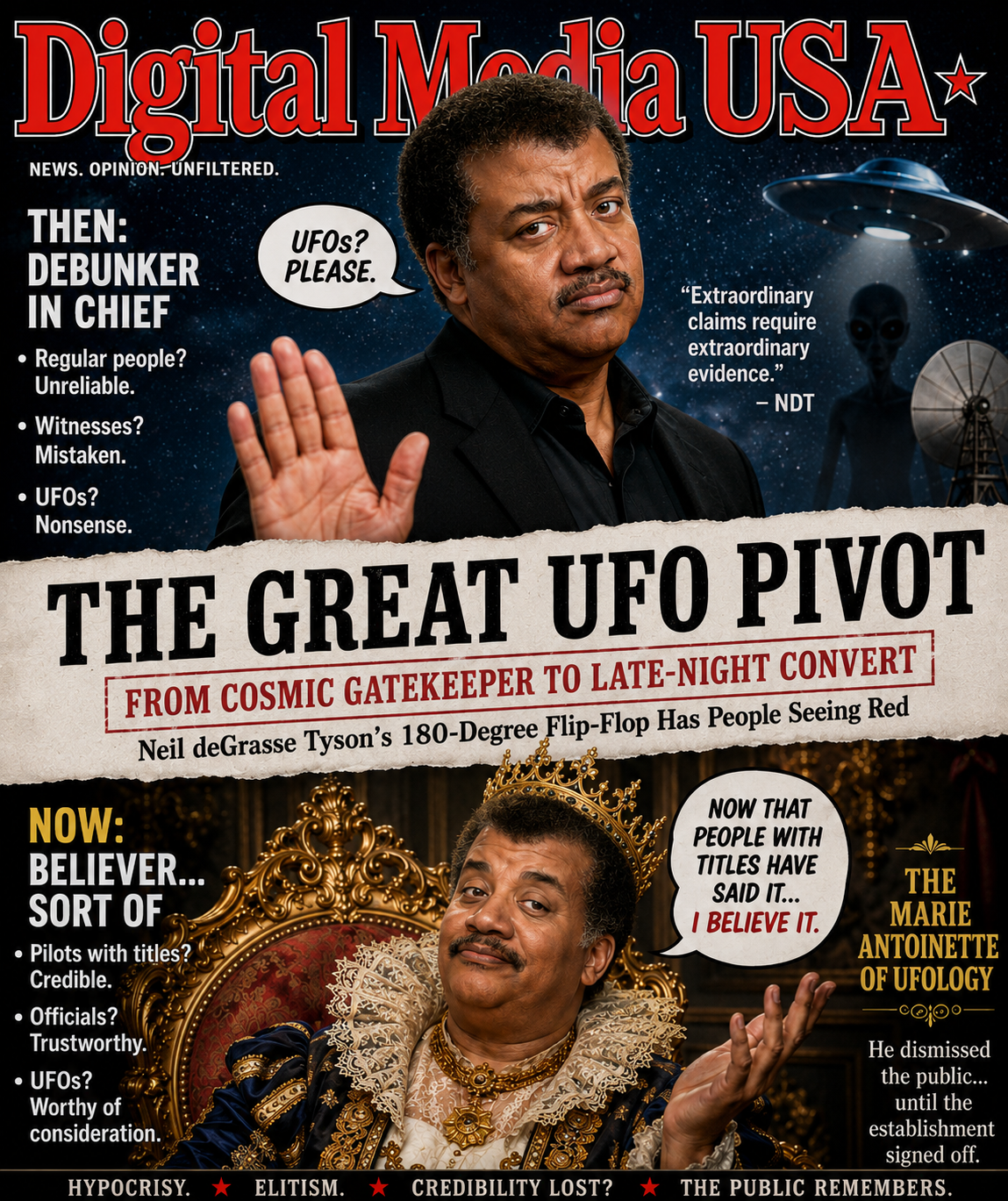
For years, Neil deGrasse Tyson played the role of America’s smug cosmic hall monitor. If you brought up UFOs, alien encounters, military sightings, or unexplained aerial phenomena, Tyson would practically roll his eyes through the television screen. To him, the topic belonged somewhere between Bigfoot conventions and a guy named Earl explaining moon lasers behind a gas station at 2 a.m.
The message was always the same: ordinary people are unreliable. Pilots? Mistaken. Witnesses? Emotional. Civilians? Gullible. Millions of Americans who reported strange things in the sky over decades were treated less like curious observers and more like background noise in Tyson’s polished universe of credential worship.
But now? Suddenly the tune has changed.
Now that decorated Navy pilots, intelligence officials, Pentagon insiders, and government-linked whistleblowers have stepped into the spotlight, Tyson has softened. Considerably. The same phenomenon he once swatted away with condescending late-night smirks is now, apparently, worthy of “serious consideration.” Why? Because people with titles said it.
That’s the part sticking in people’s craw.
Not the skepticism itself — skepticism is healthy. Science should ask questions. But Tyson’s brand of skepticism often came wrapped in something uglier: intellectual elitism. The implication was never simply “we need better evidence.” It was more like: “If regular people saw it, it probably doesn’t matter.”
That’s a dangerous worldview for someone who built a career pretending to be science’s friendly neighborhood ambassador.
The irony here is thick enough to land on radar. For decades, thousands of military personnel, police officers, airline pilots, radar operators, and everyday Americans described encounters they couldn’t explain. Tyson dismissed the entire cultural phenomenon with the kind of detached arrogance usually reserved for aristocrats peering down from palace balconies.
Now that senators are holding hearings and officials with shiny résumés are speaking in serious tones, suddenly the topic isn’t ridiculous anymore.
So what changed? The evidence? Or the social class of the people presenting it?
That’s why critics are starting to see Tyson less as a fearless scientific thinker and more as the Marie Antoinette of UFO disclosure — a celebrity intellectual so insulated inside elite academia and television culture that he mistook public curiosity for stupidity. To Tyson, the average American apparently couldn’t be trusted to describe what they saw in the sky unless someone from the Pentagon translated it first.
And the public notices hypocrisy fast.
Especially in an age where trust in institutions is collapsing faster than cable TV ratings. People remember who laughed at them. They remember who mocked the subject outright. And they definitely notice when the same media personalities quietly reposition themselves once the political and institutional winds shift direction.
Tyson now occupies a strange new orbit: not quite a believer, not quite a debunker, but something potentially worse in the eyes of critics — a gatekeeper who only grants legitimacy once elite approval arrives stamped and notarized.
Maybe that’s the real story of modern UFO disclosure. Not aliens. Not spacecraft. But the uncomfortable realization that America’s scientific priesthood often listens less to evidence than to hierarchy.
For years, Tyson asked the public to “trust the science.” What many people hear now is something else entirely:
Trust the titles.