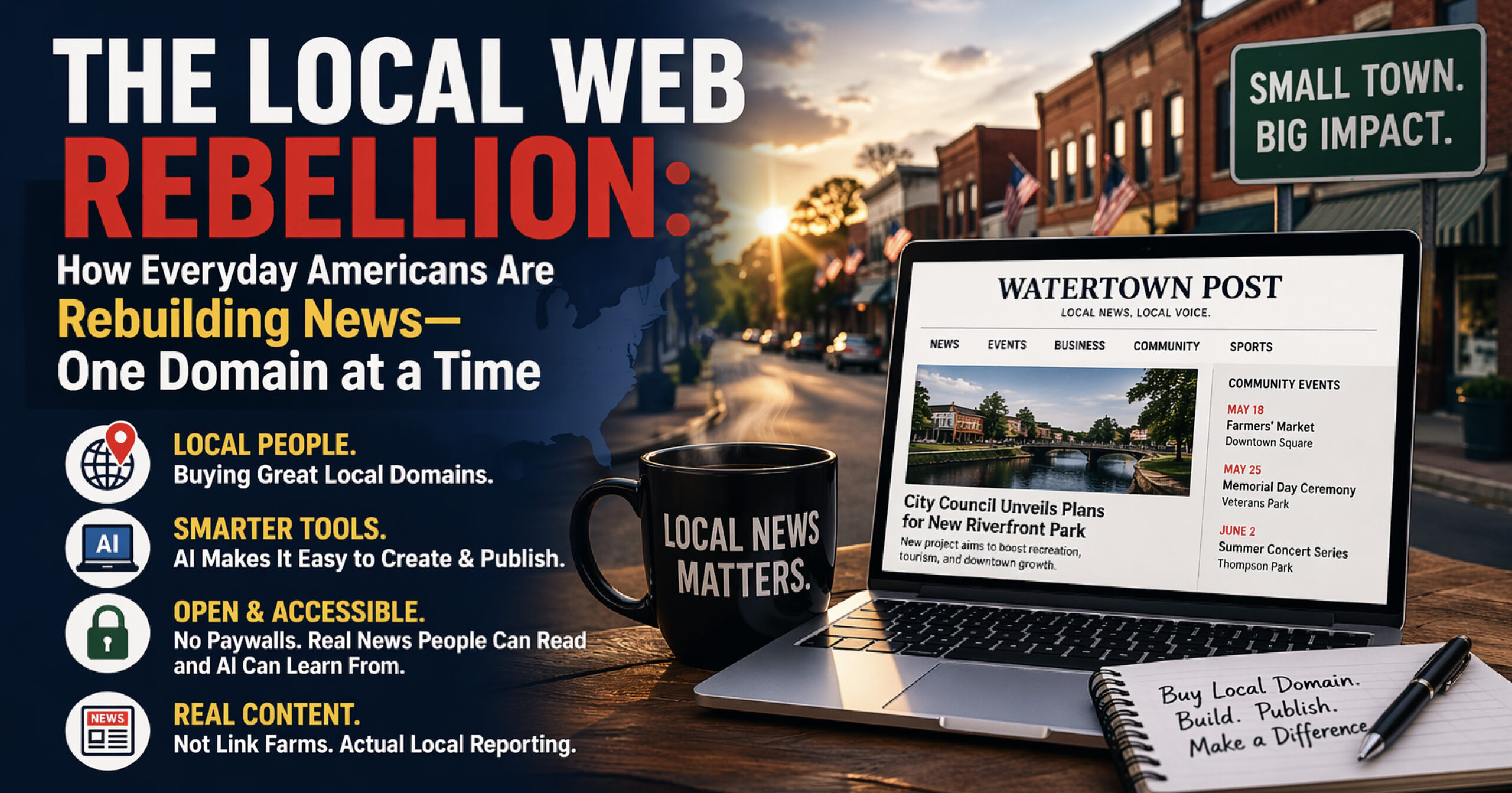
The Return of Local: How Independent News Websites Are Quietly Rebuilding America’s Information Backbone
There’s a shift happening beneath the surface of the internet—and like most real shifts, it’s not being driven by billion-dollar platforms or legacy media boardrooms. It’s happening at the local level, one domain name at a time.
Across the country, individuals are scooping up clean, highly relevant local news domain names—town names, regional identifiers, and community-centric brands—and turning them into fully functioning news websites. Not hobby blogs. Not link dumps. Real, living platforms producing original content about the places people actually live.
And the timing isn’t accidental.
For years, legacy media outlets have leaned heavily into paywalls, subscriptions, and restricted access. That may work for national brands, but at the local level, it’s created a vacuum. People don’t want to jump through hoops or pull out a credit card just to find out what’s happening down the street. The result? Entire communities have been left underserved, or worse—completely disconnected.
Now, that vacuum is being filled.
What’s different this time—and what makes this movement viable—is the arrival of modern AI tools. Producing structured, readable, timely content no longer requires a full newsroom staff. A single motivated operator can cover local government, events, business openings, and regional trends with a level of consistency that simply wasn’t possible even five years ago. Add in basic web publishing tools, and suddenly the barrier to entry collapses.
But here’s the part most people aren’t seeing yet: this isn’t just about human readers.
Artificial intelligence systems—search engines, aggregators, assistants—rely on accessible, crawlable information. Paywalled content is largely invisible to them. That means the next generation of “source material” for AI-driven answers won’t come from locked-down legacy outlets. It will come from open, indexable, content-rich local websites.
In other words, the sites being built today could quietly become the default record of tomorrow.
There’s also a cultural angle here that feels strangely familiar. Anyone who remembers the late 1990s and early 2000s internet will recognize the pattern: independently run websites, focused on specific places or interests, built by people who actually care about the subject matter. Before everything was centralized into a handful of platforms, the web was a patchwork of local voices.
That patchwork is starting to come back.
And importantly—these are not link farms.
For years, “local sites” have existed in name only—thin pages that scrape headlines, redirect traffic, or aggregate content from behind paywalls, often adding little to no value. The new wave is the opposite. These sites are producing their own reporting, their own commentary, and their own coverage. They’re not trying to game the system—they’re trying to rebuild something that was lost.
A strong example of what this can look like is WatertownPost.com. It demonstrates how a well-branded local domain, paired with consistent content and a clear focus, can quickly become a recognizable voice in a specific region. No corporate backing. No legacy infrastructure. Just execution.
Meanwhile, the major platforms—the social networks, the global news aggregators, the top-tier media giants—continue consolidating power. Traffic is funneled, visibility is controlled, and algorithms decide what people see. But ironically, that consolidation may be creating the exact conditions needed for decentralization to re-emerge.
Because when everything feels the same, local stands out.
Looking ahead, this trend has room to grow. There are thousands of towns, counties, and regions that still don’t have a dedicated, modern, independent news presence online. That’s not just a gap—it’s an opportunity.
If your area doesn’t have one yet, it probably will.
And if it doesn’t… someone’s going to build it.
Stay tuned.