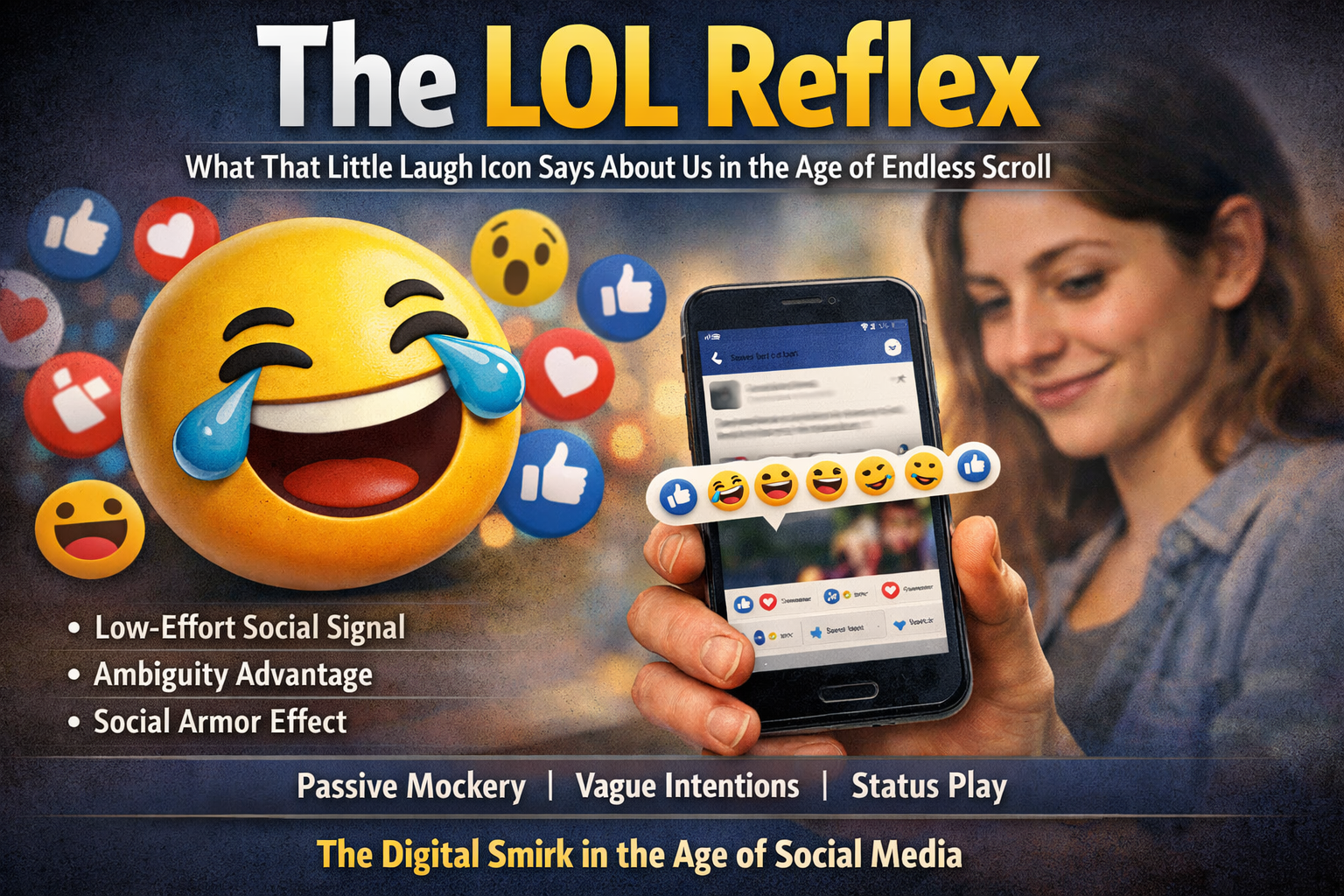
There’s a certain species of social media user you’ve seen a thousand times.
You post something mildly amusing—maybe even serious—and within seconds, there it is: the “Haha” reaction. Not a comment. Not a thought. Just that little yellow face, grinning like it knows something you don’t.
At first glance, it seems harmless. A digital chuckle. But like most things in the social media ecosystem, it’s doing more psychological work than meets the eye.
The Low-Effort Social Signal
The “Haha” reaction is one of the easiest ways to engage without actually engaging.
Psychologists call this low-effort signaling—a way of saying “I saw this, I’m here, I reacted” without investing time or vulnerability. It’s the equivalent of a head nod in a crowded room.
Why people use it constantly:
- It requires zero explanation
- It avoids the risk of saying the “wrong” thing
- It keeps them visible in your social orbit
In short: it’s participation without commitment.
The Ambiguity Advantage
Unlike a comment, the laugh reaction is intentionally vague.
Is the person laughing with you… or at you?
That ambiguity is the point.
People who lean heavily on the “Haha” reaction often prefer plausible deniability. If challenged, they can always say:
“Relax, I just thought it was funny.”
This makes the reaction a subtle tool for:
- Passive disagreement
- Light mockery
- Social distancing
It’s the digital version of a smirk across the room.
The Social Armor Effect
For some users, the constant laugh reaction is less about humor and more about protection.
Social media is a minefield. Every comment can be screenshotted, misinterpreted, or argued over. The “Haha” reaction acts like armor:
- No words = no accountability
- No position = no backlash
- No argument = no stress
It allows users to stay involved while remaining untouchable.
The Status Play
There’s also a quieter dynamic at work: status positioning.
Reacting with laughter—especially to serious or emotional posts—can subtly signal:
- “I’m above this”
- “I’m not taking this seriously”
- “I see through this”
In certain circles, that detached amusement becomes a kind of social currency. The less you appear emotionally invested, the more you project control.
It’s not always intentional—but it’s rarely accidental.
The Habit Loop
Of course, not everyone is playing psychological chess.
For many users, the “Haha” reaction is simply habitual.
Social platforms are engineered around dopamine loops:
- Scroll
- Tap
- Move on
Over time, people default to one reaction—often the laugh—because it’s fast, familiar, and satisfying. It becomes muscle memory for the thumb.
When It Actually Means… Nothing
Here’s the twist: sometimes the “Haha” really does just mean “that made me laugh.”
No hidden message. No strategy. No subtext.
But the problem with social media is that context is everything—and context is usually missing. So even the simplest reaction can be interpreted ten different ways depending on who’s looking at it.
The Digital Smirk Era
The rise of reaction-based communication marks a shift in how people interact online.
We’ve moved from:
- Conversations → reactions
- Dialogue → signals
- Meaning → interpretation
The “Haha” icon isn’t just a laugh. It’s a compressed emotional shortcut, carrying everything from genuine amusement to quiet dismissal.
And the people who use it the most?
They’ve figured out something fundamental about the modern internet:
You don’t have to say anything at all to say something.
Bottom line:
That little laughing face might be the most passive-aggressive, non-committal, socially efficient tool ever created.
And the next time you see it pop up on your post, you might want to ask yourself:
Were they laughing… or just staying safely out of the conversation?

