-West Palm Beach By Hans Wilder
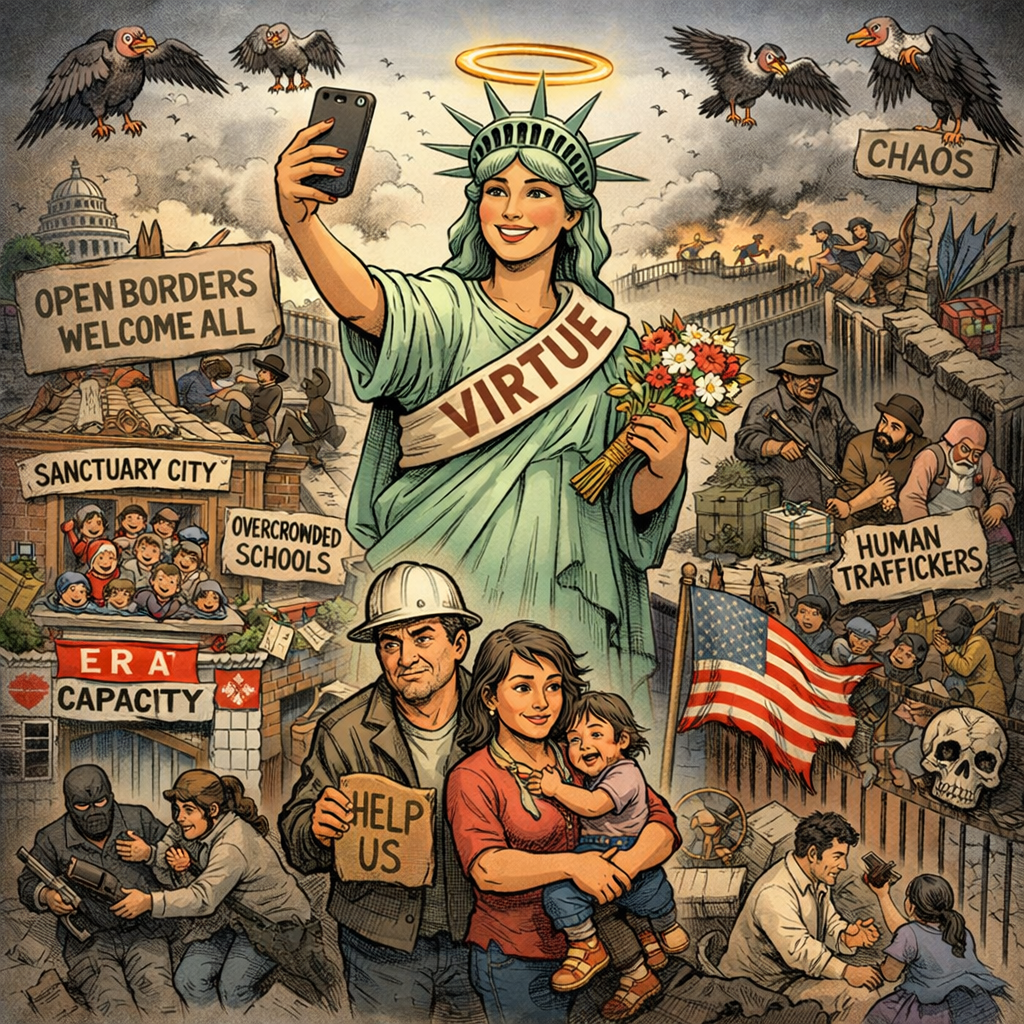
In politics, there is a dangerous habit that surfaces from time to time—leaders and activists making decisions not because they work, but because they make them feel morally superior. When it comes to unchecked, illegal immigration, this phenomenon has increasingly taken the form of what might be called suicidal vanity.
It is the urge to appear compassionate at any cost—even when the cost is borne by the very society expected to absorb the consequences.
Across the Western world, and particularly in the United States, immigration has become less about policy and more about performative morality. Political leaders compete not to design sustainable systems, but to demonstrate who can appear the most virtuous in public discourse.
The results are predictable.
Border enforcement is portrayed as cruelty.
Immigration laws are treated as suggestions.
And anyone who raises concerns about economic strain, housing shortages, crime, or cultural stability is quickly labeled intolerant.
Yet nations, like households, operate within limits. Compassion without boundaries is not policy—it is a gesture, and gestures do not run infrastructure, fund schools, or maintain public safety.
What critics of open-border ideology increasingly point out is the paradox at the heart of it all: the same political factions that speak endlessly about protecting vulnerable populations often ignore the working-class communities most affected by uncontrolled migration.
In cities across America, schools struggle to absorb sudden population surges. Hospitals face increased strain. Housing markets tighten. Social services stretch thin. Wages for low-skill workers face downward pressure.
But acknowledging these realities risks puncturing the image of moral purity.
And that is where suicidal vanity enters the picture.
Rather than confront the real-world consequences of policy decisions, some leaders double down. Failure is reframed as virtue. Criticism is dismissed as prejudice. The debate becomes less about outcomes and more about signaling moral identity.
Economist Milton Friedman once famously observed that you cannot simultaneously have open borders and a welfare state. His point was not ideological but structural. Systems designed to provide benefits to citizens cannot function indefinitely when the population drawing from them expands without limit.
Ignoring that reality does not make it disappear.
A functioning immigration system requires three basic elements:
legal entry channels, enforceable borders, and assimilation into the host society. Remove any one of those pillars and the system begins to destabilize.
Today, the United States increasingly operates in a strange hybrid model—strict laws on paper paired with selective enforcement in practice. The result satisfies neither side of the debate. It fuels resentment, encourages dangerous migration journeys, and empowers criminal smuggling networks that profit from chaos.
Perhaps the most troubling aspect of the current moment is that many of the loudest advocates for unlimited compassion rarely live in the communities most affected by the policies they champion. Their neighborhoods remain stable. Their schools remain orderly. Their housing markets remain insulated.
The consequences fall elsewhere.
This disconnect is why immigration debates have become so heated. It is not simply about demographics or economics—it is about credibility.
When policy becomes an exercise in moral vanity rather than responsible governance, the public eventually notices.
History shows that nations capable of balancing generosity with realism thrive. Those that allow ideology to override practical limits often find themselves facing crises that could have been avoided.
Immigration has always been part of the American story. It built the country and continues to enrich it.
But successful immigration systems are built on order, law, and shared expectations—not on the fragile foundation of political virtue signaling.
Because when vanity becomes policy, reality eventually sends the bill.