-West Palm Beach by Hans Wilder
For years, calls for universal basic income were easy to dismiss as fringe economics — the kind of thing debated in college dorm rooms or waved around at protest rallies. Critics called it socialism. Supporters called it justice. Most policymakers called it unrealistic.
Now enter artificial intelligence.
Not the sci-fi version. The real one. The kind quietly replacing paralegals, coders, designers, call centers, drivers, editors, accountants, and even portions of medical diagnostics. AI is not just automating factory lines anymore — it’s automating cognition. And it’s doing it at exponential speed.
That changes everything.
The Economics No One Wants to Admit
When productivity explodes while labor demand contracts, something has to give. You can’t have an economy where output rises dramatically but wage participation collapses. Consumption drives growth. No wages, no consumers. No consumers, no growth.
That’s where universal income — or something very close to it — stops being ideological and starts becoming structural.
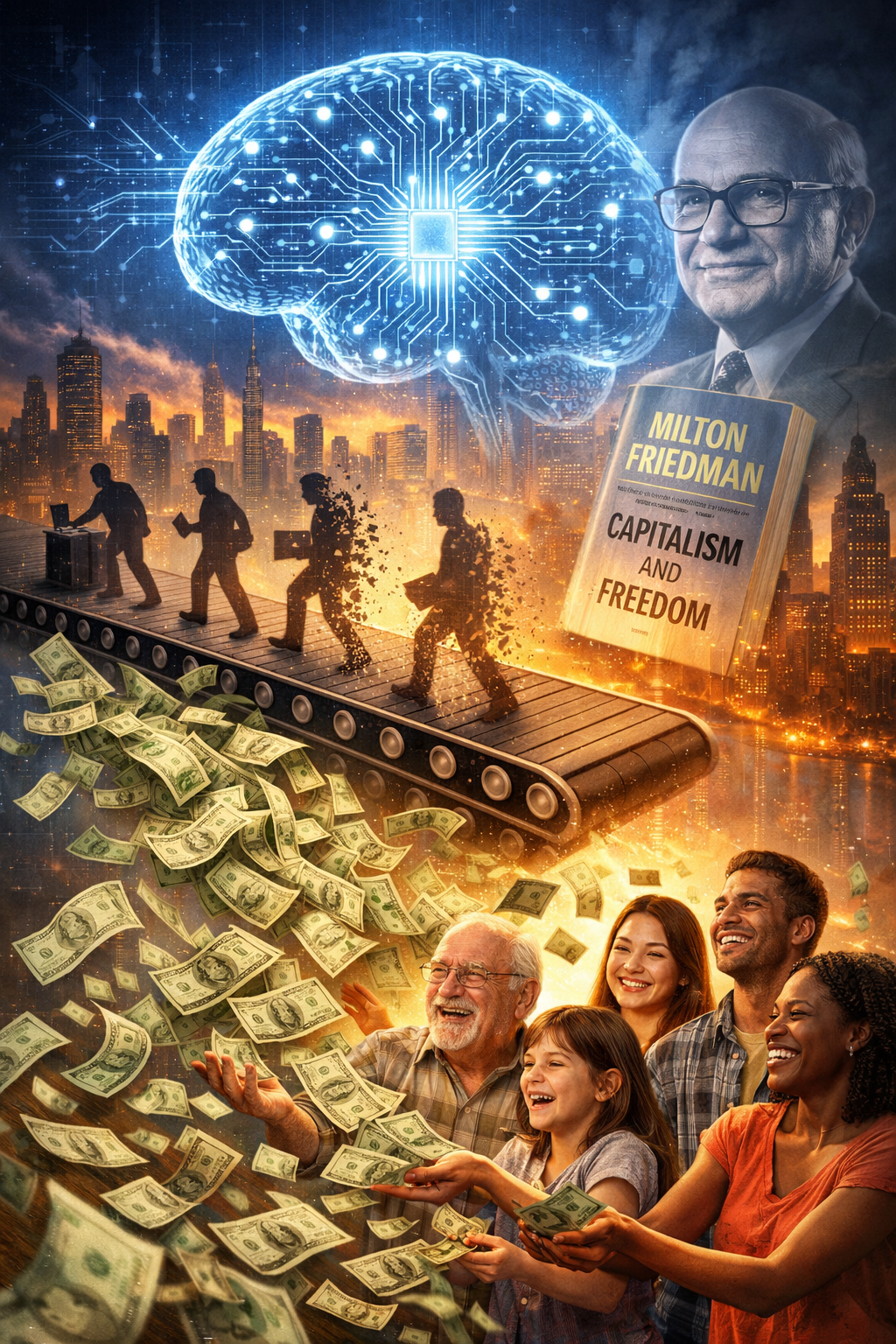
Ironically, one of the earliest serious proposals for a guaranteed income didn’t come from a socialist. It came from free-market economist Milton Friedman.
Milton Friedman’s Negative Income Tax
Friedman proposed the Negative Income Tax (NIT) in the 1960s as a way to streamline welfare while preserving work incentives.
Here’s how it works:
- Set a minimum income threshold (for example, $30,000 per year).
- If someone earns less than that, the government supplements a percentage of the difference.
- If someone earns nothing, they receive a base payment.
- As they earn more, the payment phases out gradually instead of disappearing abruptly.
Example:
If the threshold is $30,000 and the subsidy rate is 50%, someone earning $0 would receive $15,000.
If they earn $10,000, they’d receive $10,000 (half of the $20,000 gap).
The benefit declines as income rises, avoiding the “welfare cliff.”
Friedman liked it because:
- It simplified bureaucracy.
- It maintained work incentives.
- It replaced multiple fragmented welfare programs.
- It preserved market dynamics while preventing destitution.
It wasn’t socialism. It was a market stabilizer.
Why AI Changes the Timeline
For decades, negative income tax or universal basic income was optional. A theoretical discussion.
AI makes it less theoretical.
Artificial intelligence improves at an exponential rate. Each generation of models improves training data for the next. Hardware scales. Costs drop. Deployment widens. Adoption accelerates. That curve is not linear — it’s compounding.
We are already seeing:
- Automated legal research
- AI-generated marketing
- Autonomous logistics planning
- AI-assisted coding
- Synthetic media replacing creative labor
- AI customer service replacing call centers
This isn’t a 50-year horizon discussion. It’s a 5- to 15-year structural shift.
If even 20–30% of white-collar cognitive work becomes automated in that timeframe, the pressure on wage structures becomes unavoidable.
The Political Irony
The loudest advocates for universal income historically came from socialist and communist traditions. But the actual implementation, if it happens, will likely look far more like Friedman’s negative income tax than a collectivized state wage.
Why?
Because governments will need to:
- Stabilize consumer demand.
- Prevent mass unemployment unrest.
- Preserve private markets.
- Avoid expanding massive bureaucracies.
- Maintain social cohesion during technological transition.
That pushes policymakers toward a streamlined income floor — not a command economy.
In other words:
The policy might resemble something the free-market camp proposed decades ago.
The Real Question: When?
If AI continues on its current trajectory:
- 5 years: Significant job displacement in administrative, legal, marketing, and creative sectors.
- 10 years: Large-scale automation in logistics, mid-level analysis, customer operations, and programming support.
- 15 years: Structural labor participation shifts requiring systemic policy intervention.
At that point, income stabilization mechanisms won’t be philosophical debates. They’ll be economic necessities.
The Future Won’t Be Ideological — It Will Be Mathematical
When labor participation declines but production rises, the economy either redistributes purchasing power or collapses into deflationary stagnation.
Universal income — whether branded as UBI, negative income tax, or something else entirely — becomes less about fairness and more about keeping the machine running.
The socialists may cheer.
The free-market economists may sigh and say, “We suggested something like this 60 years ago.”
And AI will keep scaling, indifferent to the argument.
The real story isn’t whether universal income is “right” or “left.”
It’s whether artificial intelligence leaves policymakers any other choice.
Digital Media USA — Analysis on technology, markets, and the structural shifts reshaping the American economy.