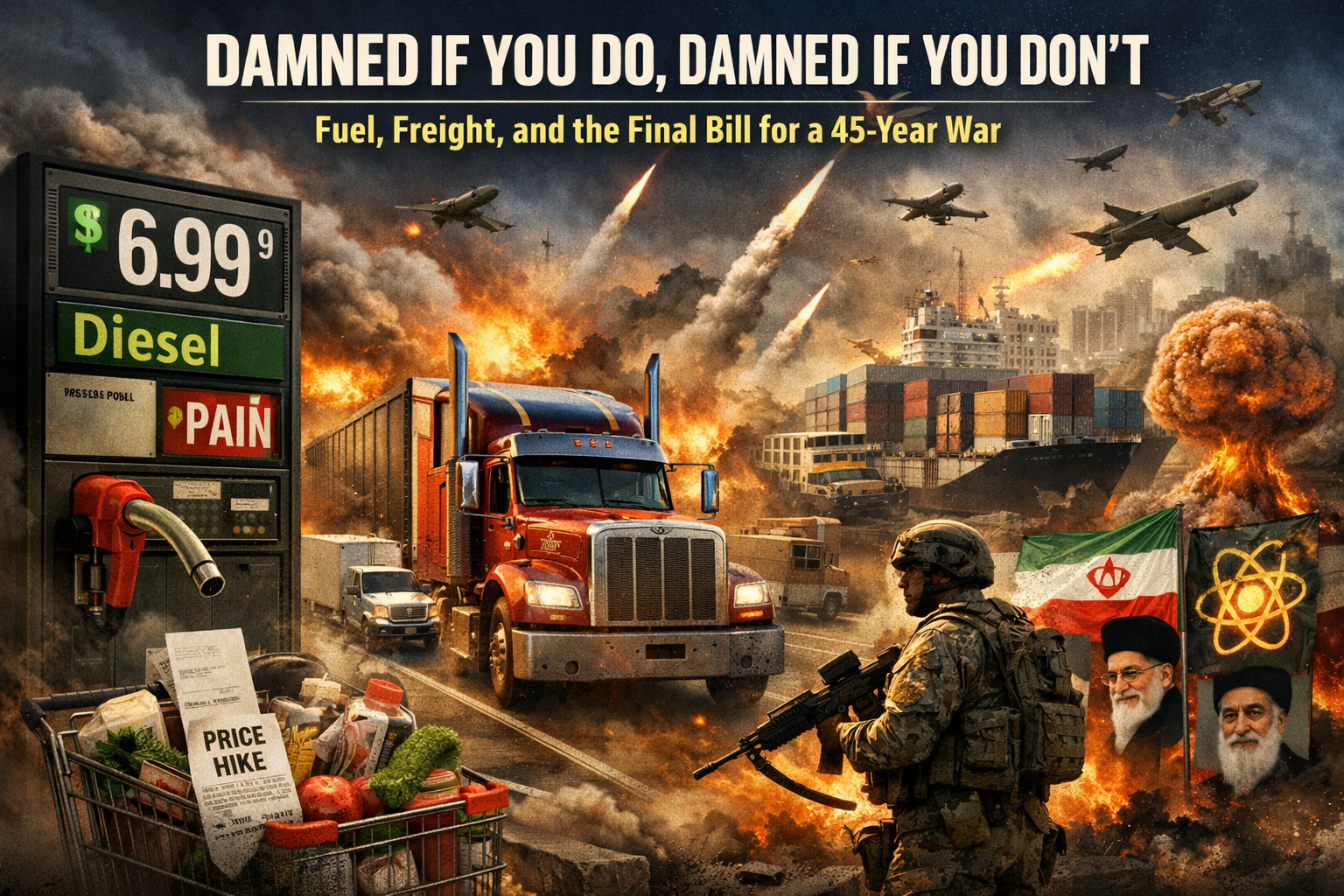
Fuel, Freight, and the Final Bill for a 45-Year War
By Digital Media USA
There are moments in history where the bill finally comes due.
Not the kind you can refinance. Not the kind you can kick down the road with another continuing resolution, another speech, another “we’ll deal with it later.” This one lands all at once—at the pump, in the grocery aisle, in diesel prices, in shipping costs, and ultimately in the cost of simply living.
That’s where we are now.
Diesel is climbing. Trucking costs are surging. Supply chains—already stretched thin—are tightening again. And when diesel spikes, everything spikes. Food. Construction. Retail. Energy. The entire economic ecosystem runs on trucks, and trucks run on diesel. It’s not complicated—it’s physics and logistics, not politics.
But what’s driving it is something much deeper than markets.
This is the accumulated pressure of a conflict that didn’t start last month, last year, or even this decade. This is the long tail of a war that traces back to 1979—through proxy battles, insurgencies, roadside bombs, sanctions, shadow conflicts, and a constant state of “almost escalation.”
And now, it’s no longer almost.
The Trap: Pay Now or Pay Later
Here’s the reality no one likes to say out loud:
- If you act, prices spike, markets react, and there’s immediate pain.
- If you don’t act, the threat grows, risks compound, and the eventual cost becomes existential.
That’s the damned-if-you-do, damned-if-you-don’t moment.
For decades, the strategy has been containment. Delay. Manage the problem. Keep it just below boiling. But history has a way of punishing prolonged indecision. Problems that are managed—but not resolved—don’t disappear. They mature.
And now we’re staring at the mature version.
Why Diesel Is the Canary in the Coal Mine
Diesel doesn’t lie.
It reflects global instability faster than almost anything else. When tensions rise in energy-critical regions, diesel reacts. When shipping routes are threatened, diesel reacts. When risk premiums get baked into global trade, diesel reacts.
And when diesel reacts, everything else follows.
The grocery bill you see this week? That’s diesel from two weeks ago.
The construction costs next month? That’s diesel today.
The inflation reports down the line? That’s diesel echoing through the system.
So when diesel spikes during a geopolitical escalation, it’s not just a number—it’s a signal that the cost of stability is being repriced in real time.
The Strategic Reality
For years, the concern has been clear: what happens if a hostile regime gains the ultimate leverage—nuclear capability combined with asymmetric tools?
Not just missiles, but drones. Not just armies, but networks. Not just battlefields, but infrastructure, cyber systems, and civilian targets.
We’re not in the 1990s anymore. Warfare has changed.
Today, threats don’t arrive in neat formations. They can come in swarms. From ships. From trucks. From hidden launch points. From within.
That’s the calculation now:
Is short-term economic pain worse than long-term strategic vulnerability?
Because once certain thresholds are crossed, there’s no undo button.
The “D-Day” Moment
Every generation faces a moment where avoidance is no longer an option.
Call it a reckoning. Call it a pivot point. Call it what you want—this is one of those moments.
The comparison isn’t about spectacle. It’s about decision-making under pressure. A point where leadership stops managing optics and starts making irreversible choices.
And those choices come with costs.
Real costs:
- Higher fuel
- Higher goods
- Market volatility
- Military risk
There’s no scenario here where everything stays comfortable.
The Uncomfortable Truth
No one wants higher prices. No one wants conflict. No one wants instability.
But pretending those things can always be avoided hasn’t worked.
What we’re seeing now is the collision between two realities:
- The economic system we depend on
- The security environment that underpins it
When those two collide, the result is exactly what we’re seeing—price spikes tied directly to geopolitical risk.
What Comes Next
If this truly is the “final phase” of a decades-long conflict, then the next stretch will test more than just markets.
It will test:
- Supply chain resilience
- Energy independence
- Military readiness
- Public tolerance for short-term hardship
Because the uncomfortable part is this:
Stability isn’t free.
It never has been.
Bottom Line
You’re paying for it now—at the pump, at checkout, in your monthly bills.
The question isn’t whether there will be pain.
The question is whether that pain is the cost of finally resolving something that’s been left unresolved for nearly half a century.
Because one thing is certain:
Kicking the can got us here.
And now, there’s nowhere left to kick it.