By Hans Wilder | Digital Media USA
I’ve been writing about technology long enough to remember when a website getting ten comments was considered a busy day.
Then came Facebook.
Then came algorithms.
Now we’ve entered a new phase where, in many political races, the first battle isn’t over ideas. It’s over emojis.
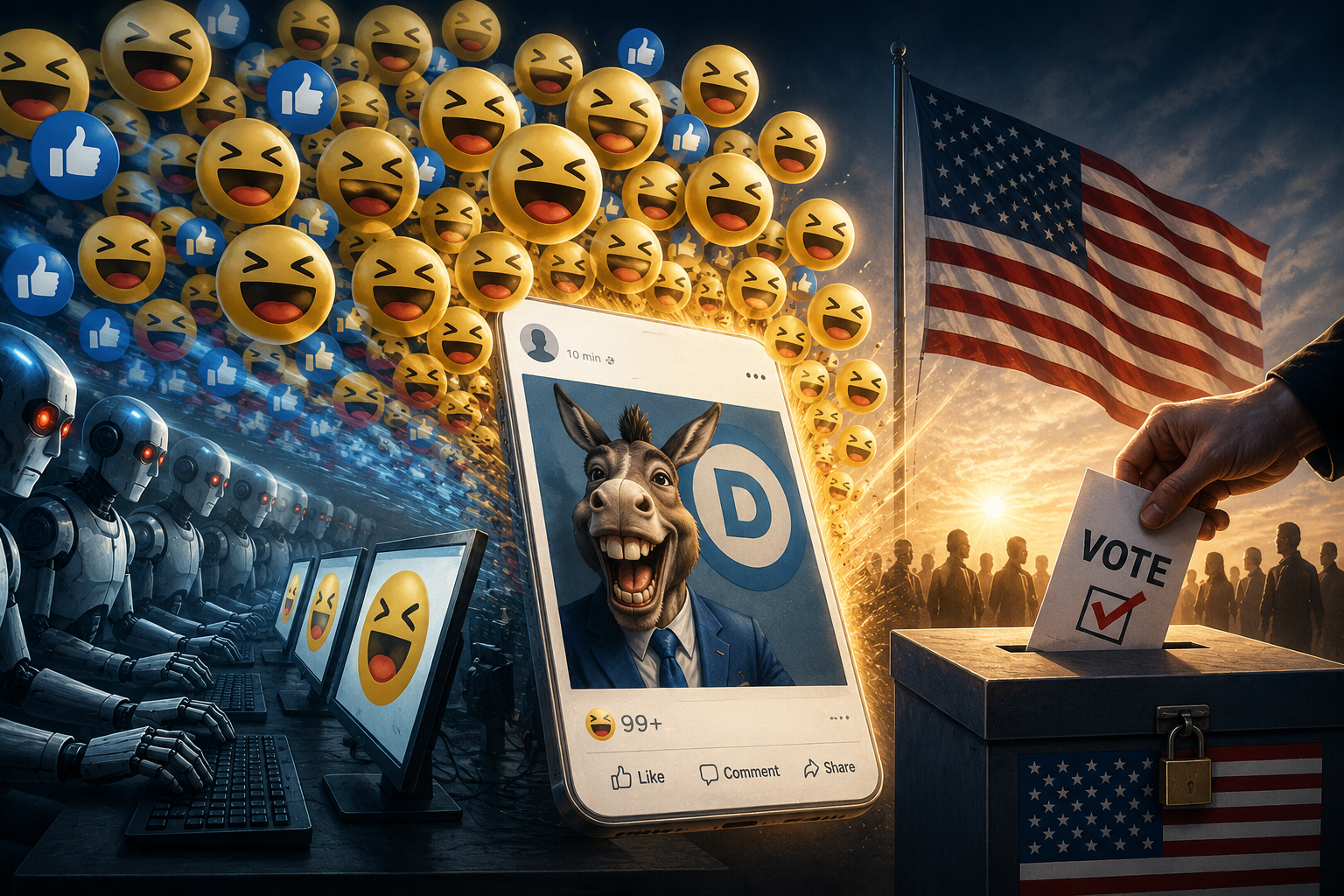
Over the past week, following Anthony Constantino’s decisive victory in New York’s 21st Congressional District Republican primary, something curious has appeared across social media. Posts about Constantino are often met almost immediately with waves of laughing-face reactions. Sometimes the reactions pile up within minutes. Frequently the same handful of memes appear over and over again from accounts that look remarkably similar.
Could every one of those accounts belong to real people? Certainly.
Could coordinated online groups be involved? That’s also possible.
The important point isn’t who is pressing the button. It’s why the button exists in the first place.
Political strategists understand something psychologists have studied for years: people are heavily influenced by social proof. When individuals encounter a post that already appears unpopular or mocked, many unconsciously assume that “everyone else” has already reached a conclusion. It saves mental effort. Instead of evaluating information independently, people often let the crowd make the first impression.
That’s why reactions have become valuable political real estate.
The laughing emoji isn’t really about laughter.
It’s about framing.
It’s intended to signal, “This person isn’t serious.”
Whether that’s deserved or completely unfair almost becomes secondary because the emotional judgment arrives before anyone actually reads the article.
Ironically, this strategy has a weakness that traditional political consultants sometimes overlook.
Unlike a detailed rebuttal, a laughing emoji contains no argument.
It doesn’t explain why taxes should be higher or lower.
It doesn’t explain immigration policy.
It doesn’t explain manufacturing.
It doesn’t explain energy.
It simply attempts to create an emotional shortcut.
And emotional shortcuts eventually run into reality.
Anthony Constantino just demonstrated that in his Republican primary. Despite a contentious campaign, he won decisively with strong turnout after earning President Trump’s endorsement, setting up a general-election contest against Democrat Blake Gendebien.
If thousands of people genuinely disagreed with him and wanted to debate policy, one would expect thousands of thoughtful comments explaining why.
Instead, what many observers notice are reaction emojis and recycled image macros.
That may create the appearance of overwhelming opposition, but appearances can be manufactured surprisingly cheaply in today’s internet economy.
Marketing firms around the world openly sell engagement services. Coordinated online communities also organize reaction campaigns. Social media platforms have spent years removing networks engaged in what they call “coordinated inauthentic behavior,” precisely because manufactured engagement can distort public perception. None of that means every burst of reactions is fake, but it does mean reaction counts alone should never be mistaken for genuine public opinion.
As someone who has spent nearly two decades watching the evolution of online media, I find this trend fascinating.
Ten years ago campaigns fought over television ads.
Five years ago they fought over viral videos.
Today they’re fighting over the first three seconds after someone scrolls past a Facebook post.
The irony is that elections are still decided in voting booths, not by emoji counters.
A laugh reaction cannot cast a ballot.
A meme cannot fill out an absentee ballot.
And no amount of digital snickering changes what happens when actual voters walk into an actual polling place.
If anything, the sudden flood of emoji warfare says something larger about modern politics.
When campaigns begin investing more energy into shaping perceptions than debating ideas, they’ve admitted that psychology has become just as important as persuasion.
The challenge for voters is simple.
Read the article before you read the emojis.