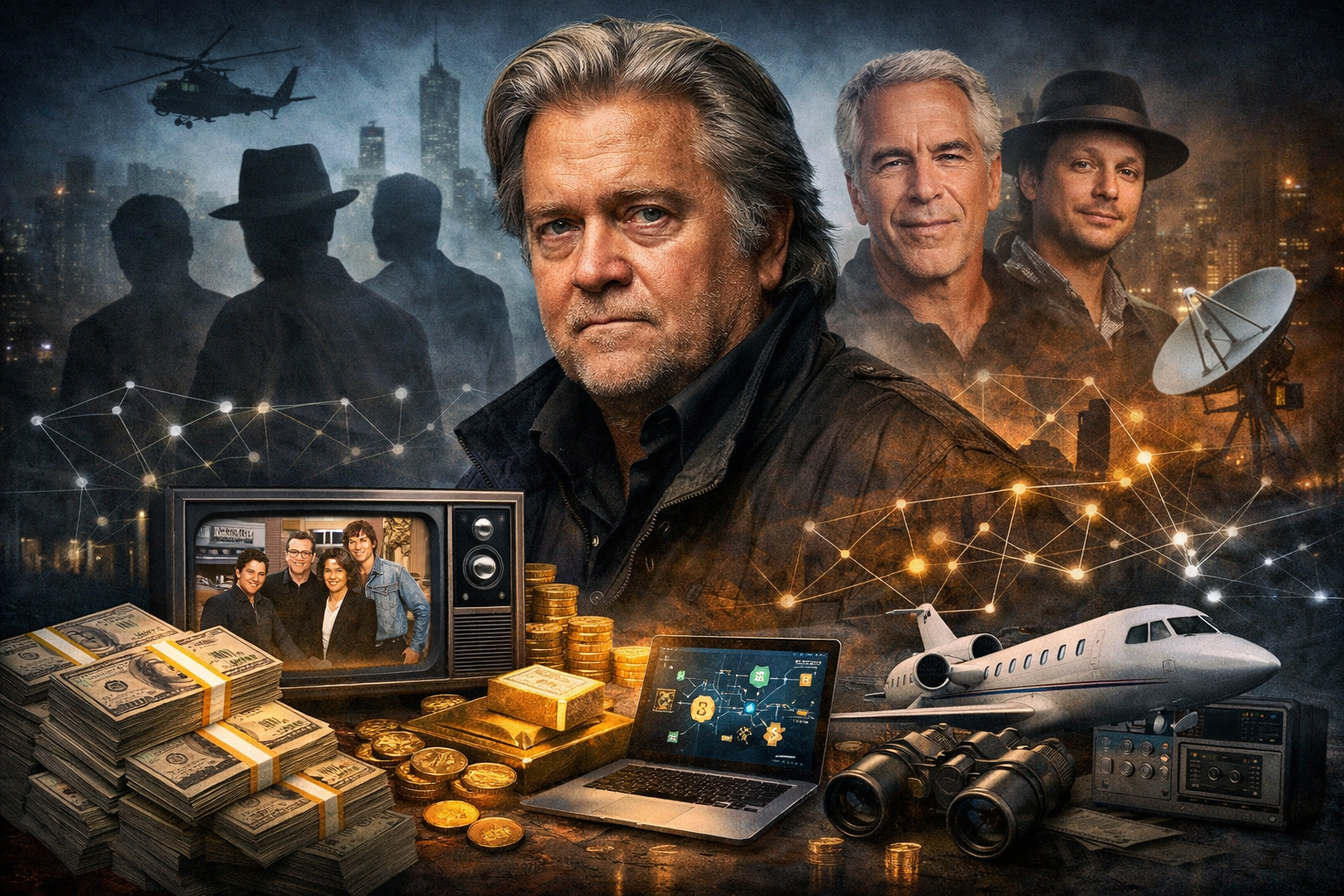
In American politics, few figures generate as much fascination—and confusion—as Steve Bannon. A former investment banker, media executive, populist strategist, and White House adviser, Bannon has spent years at the center of political storms. But beyond the politics lies another question that continues to circulate among observers: where exactly did his money and connections come from?
The speculation often grows from a handful of unusual facts about Bannon’s career, his wealth, and the network of powerful figures around him.
The “Seinfeld Money” Mystery
One of the most commonly cited details about Bannon’s finances traces back to the 1990s.
Before entering politics, Bannon worked at the investment bank Goldman Sachs and later helped structure media deals in Hollywood. During that period, he was involved in a financing arrangement connected to the hit television show Seinfeld.
The deal reportedly gave Bannon and his partners a percentage of profits from syndication rights after the show entered reruns. Because Seinfeld became one of the most successful sitcoms in television history, those syndication profits proved extremely lucrative.
However, despite rumors circulating online that Bannon is worth hundreds of millions or even close to a billion dollars, credible financial reporting generally places his personal wealth much lower, typically estimated in the tens of millions rather than the hundreds of millions.
Still, the fact remains: Seinfeld reruns have generated billions in revenue, and anyone with a small slice of that pie could see a steady income stream for decades.
Intelligence Background: Fuel for Speculation
Another element that feeds speculation about Bannon’s past is his early career.
Bannon served as an officer in the U.S. Navy, working in intelligence roles during the Cold War. Military intelligence experience is not uncommon among later political figures, but in Bannon’s case, critics and conspiracy theorists have sometimes used that background to suggest he may have maintained ties to intelligence circles.
There is no public evidence that Bannon worked as a spy after his naval service. Still, his path—from naval intelligence to investment banking to political strategy—has always struck observers as unusual.
The Jeffrey Epstein Connection
Questions about Bannon’s network intensified because of reports that he had interactions with Jeffrey Epstein.
After Epstein’s first criminal conviction in 2008, Bannon reportedly met with him on multiple occasions. Journalistic investigations later indicated that Bannon discussed media strategy and image rehabilitation with Epstein.
Some reports even suggested Bannon recorded interviews with Epstein for a possible documentary project.
There is no evidence that Bannon was involved in Epstein’s crimes, but the meetings raised eyebrows because Epstein maintained relationships with many powerful individuals across politics, finance, and academia.
The Brock Pierce Angle
Another name that occasionally surfaces in discussions of Bannon’s circles is Brock Pierce.
Pierce, a tech entrepreneur and early cryptocurrency investor, has also appeared in discussions surrounding Epstein’s social networks. While Pierce and Bannon moved in some overlapping political and financial circles over the years, there is no confirmed evidence that the two were directly collaborating in any significant venture tied to Epstein.
However, the intersection of tech investors, political operatives, and financiers during the 2000s and 2010s created a web of relationships that still draws scrutiny today.
Washington’s Reality: Overlapping Power Networks
One explanation for these overlapping names may be far simpler than spy theories.
Washington, Wall Street, and Silicon Valley operate as tight ecosystems, where powerful people often encounter one another repeatedly through investments, political campaigns, media projects, or philanthropy.
Bannon’s career placed him at the crossroads of several of these worlds:
- military intelligence
- investment banking
- Hollywood media financing
- populist political movements
That unusual mix naturally creates a long list of acquaintances and collaborators—some of whom later became controversial figures themselves.
The Bottom Line
Speculation about intelligence ties, secret money, or hidden patrons often grows around figures who move between finance, politics, and media, as Bannon has.
But when separating fact from rumor, the publicly documented pieces are fairly straightforward:
- Bannon earned money from a syndication-related investment tied to Seinfeld.
- He previously served in U.S. Navy intelligence.
- He later met with Jeffrey Epstein for reported documentary discussions.
- His broader network includes figures from tech, finance, and politics.
Whether those connections represent ordinary elite networking or something deeper remains a matter of interpretation. What is clear is that Bannon’s career—spanning intelligence, Hollywood, and populist politics—has been unusual enough to ensure the questions never fully disappear.